
Reviewed · HISTORICAL TOURS
Vienna: Time Travel and Magic Vienna History Tour
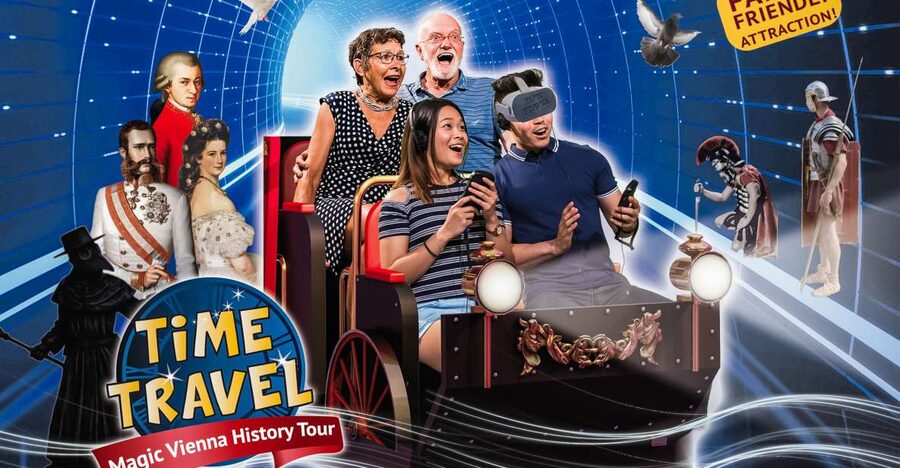
Vienna Time Travel turns 2,000 years of city history into a fast-moving show beneath the old town. You pass through cellar rooms, meet Roman settlers and Habsburg rulers, put on VR glasses for Viennese music, and finish with a virtual flight over today’s city. It is history presented as theatre, cinema, and amusement ride rather than as a quiet museum.
I like two things right away: the one-hour length keeps the presentation lively, and the changing rooms give children and adults a reason to keep paying attention. The 5D cinema, wartime bomb shelter, and final horse-drawn carriage ride are especially memorable. The main drawback is practical: about 50 steps connect the two levels, there is no elevator, and the attraction cannot accommodate wheelchair users.
Key points at a glance
- A quick route through 2,000 years: The story runs from the Roman camp of Vindobona to modern Vienna.
- Several forms of entertainment: Expect a portrait gallery, 5D cinema, VR glasses, special effects, and a simulated carriage flight.
- Strong choice for families: The short format, animated presentation, and physical effects help younger visitors stay involved.
- Useful early in your visit: It gives you a basic sense of Vienna’s past before you explore the Hofburg, Stephansplatz, and other sights.
- Easy old-town location: The entrance is at Habsburgergasse 10A, close to the Hofburg, Graben, Kohlmarkt, and Stephansplatz.
- Important access warning: Two levels include roughly 50 steps, with no elevator or wheelchair access.
What Vienna Time Travel is really like
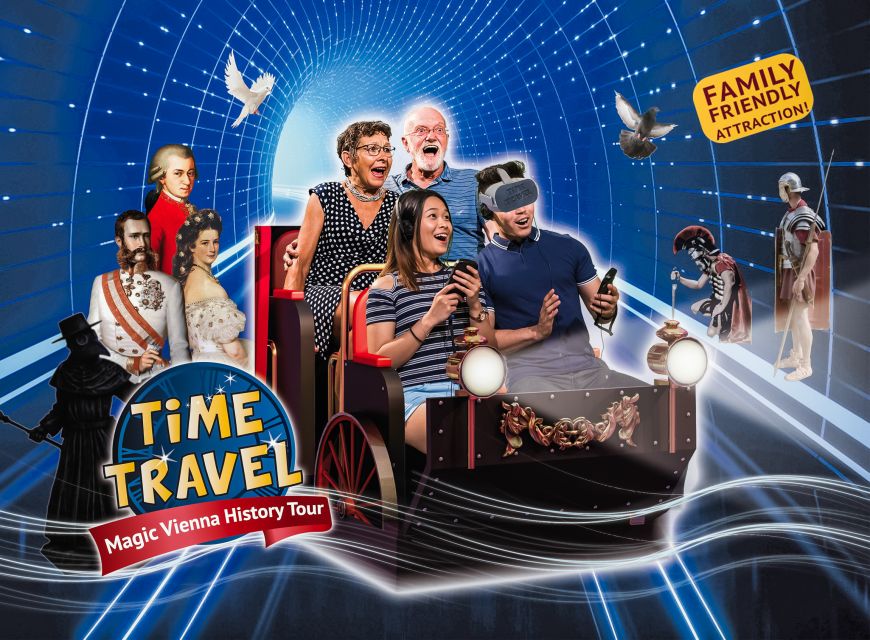
This is not a traditional guided walk, and it is not a museum where you read labels at your own pace. It is a staged indoor attraction in the extensive cellars of the St. Michael’s monastery, with a guide leading you from one scene to the next and a multilingual audio guide helping explain the story.
The group moves through several rooms. Each one covers a different period or theme, and the setting changes often enough that the hour passes quickly. You may watch animated figures, sit through a film with physical effects, use VR equipment, listen to historical voices, and finish with a simulated ride above Vienna.
That variety explains the strong overall rating of 4.6 from 3,879 reviews. The attraction is not trying to replace the Kunsthistorisches Museum or a serious history book. Instead, it gives you a broad, memorable outline of the city, with enough sensory effects to make the major events easier to remember.
I would treat it as an introduction. If you take it near the start of your stay, later visits to the Hofburg, Schönbrunn Palace, or Vienna’s churches will have more context. You will recognize the Habsburg family, understand why imperial Vienna matters, and have a clearer sense of how war and reconstruction shaped the city.
A few more Vienna trips to weigh up
- Vienna: World War II Historical Walking Tour
★ 4.8 · 1,772 reviews - Vienna Historic Center Small Group Walking Tour
★ 5.0 · 1,746 reviews - Time Travel-Magic Vienna History Tour Ticket
★ 4.5 · 1,099 reviews
Starting with Vindobona and Vienna’s early years
The story begins with Vienna’s Roman past and the ancient camp of Vindobona. This is a sensible starting point because Vienna’s location beside the Danube helped make it important long before the imperial palaces appeared.
You are not walking through an actual Roman archaeological site here. The attraction uses sets, sound, projections, and storytelling to give you a quick picture of early Vienna. The advantage is speed. You get the basic idea without spending an hour reading long panels. The limitation is that the treatment is necessarily broad, so history-minded visitors may want to follow up at a proper museum or archaeological site.
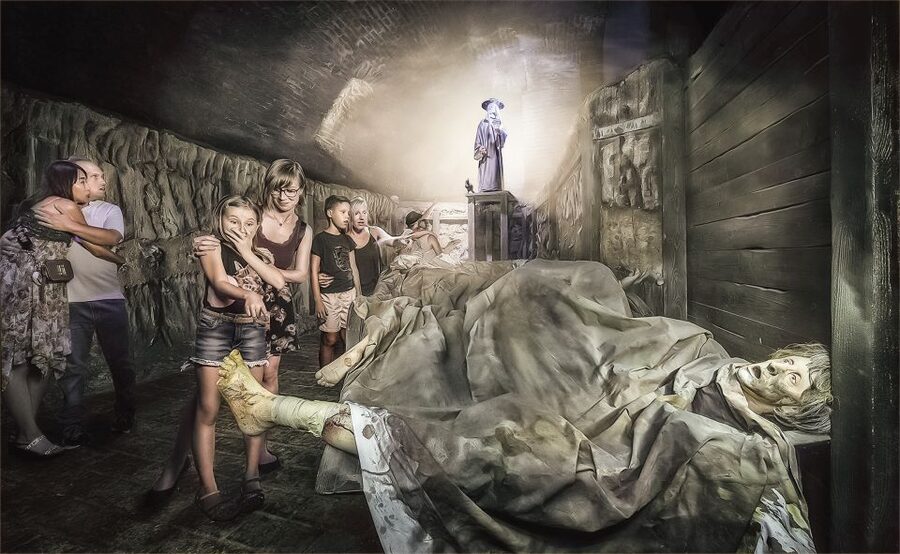
One of the early scenes presents the Black Death in Vienna. The effect is designed to be felt rather than simply explained, and it can be intense for younger children or anyone sensitive to dark historical subjects. It is also one of the moments that gives the tour emotional weight. The city’s past is not reduced entirely to palaces, music, and pretty façades.
The route keeps moving, so you do not have much time to linger in one room. That works well for families and for anyone with only a few days in Vienna. If you prefer slow, detailed interpretation, you may find the pace brisk.
Meeting Vienna’s famous faces in the portrait gallery
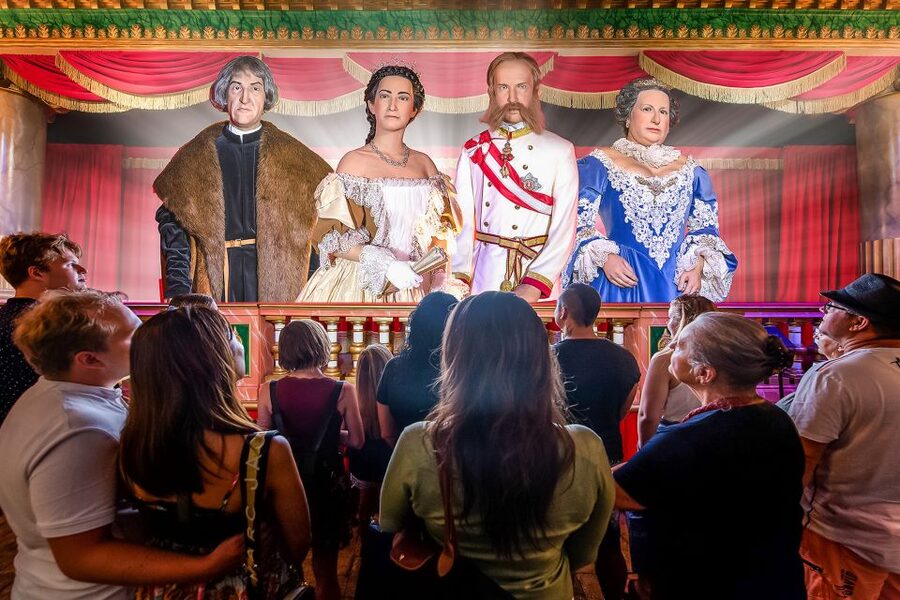
The portrait gallery introduces important people from Viennese history. You get a series of quick encounters rather than a long lecture, with figures appearing to explain their part in the city’s story.
This format makes a difficult task easier. Vienna has been shaped by rulers, composers, politicians, religious leaders, and citizens whose names can blur together during a short visit. Seeing them presented one by one gives you useful anchors.
The Habsburg family receives special attention. You meet the imperial family through theatrical displays and learn about the nobility and customs of the Viennese court. The presentation is not meant to provide a complete family tree, but it gives you enough background to understand why the Hofburg and Schönbrunn are central to Vienna sightseeing.
I especially like this part as preparation for a palace visit. The Habsburgs can feel remote when you encounter them only in formal portraits and grand rooms. Here, the attraction tries to give them personality and lets you form your own impression of the royal figures.
There is also a tradeoff. Animated figures and multimedia scenes simplify complicated people and events. You get an accessible introduction, not a detailed examination of imperial politics, succession, or daily life. Think of it as a helpful first chapter rather than the whole book.
The 5D cinema and the sensation of old Vienna
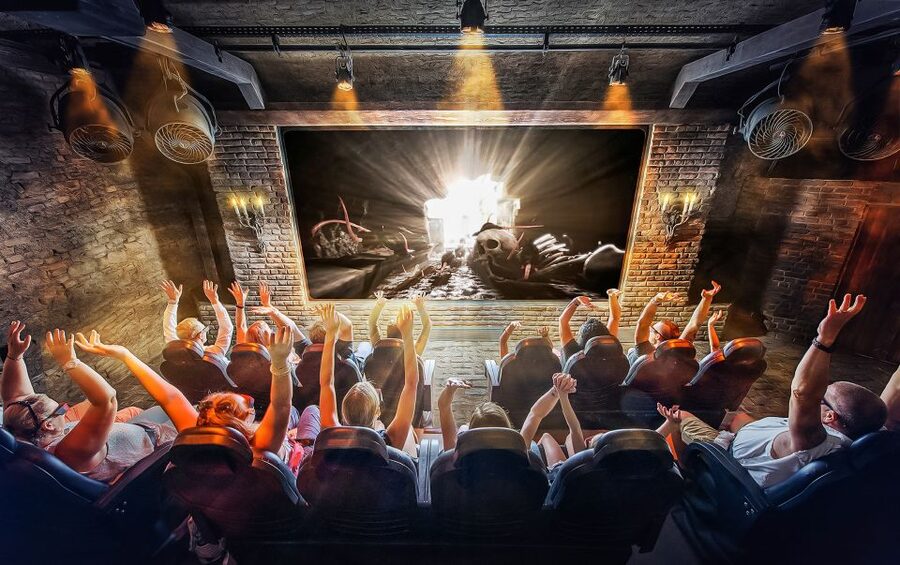
The 5D cinema is one of the main reasons people choose this attraction over a standard history display. Special effects create the feeling of being inside ancient Vienna, with movement and sensory touches adding to the film.
The movie is short, which is both good and bad. It keeps the program moving and avoids tiring children, but the sequence can feel over just as you are getting into it. If you love film attractions, you may wish this section lasted longer.
Still, the cinema gives the hour a welcome change of pace. You are not simply standing in front of another display. You sit, watch, and feel the story presented around you. The effects are playful rather than frightening overall, though the exact experience can feel more like a theme-park attraction than a historical documentary.
That distinction matters when deciding if this is right for you. Families, first-time visitors, and anyone wanting a lively introduction will probably appreciate the format. A visitor seeking quiet art, primary sources, or detailed historical argument should choose a museum instead, or pair this experience with one.
Same Alps, a completely different kind of day:
- Vienna: Vivaldi’s Four Seasons Concert in Karlskirche
★ 4.7 · 14,951 reviews - Vienna: Spanish Riding School Training
★ 3.9 · 9,281 reviews - Vienna: Skip-the-cashier-desk-line Giant Ferris Wheel Ride
★ 4.5 · 7,859 reviews - Vienna: Schönbrunn Palace & Gardens Skip-the-Line Tour
★ 4.7 · 7,739 reviews
Viennese music through virtual reality
Vienna’s music history gets its own VR section. With virtual reality glasses, you enter a simulated world built around the city’s musical past.
The attraction uses technology to show how important music is to Vienna’s identity. You are not attending a concert, and this does not replace hearing live music in the city. It does, however, provide a playful way to connect Vienna with its composers and musical traditions.
The VR section is particularly useful for families because it changes the rhythm again. After portraits, sets, and cinema, the headsets give you something hands-on to do. Children may remember this section more clearly than a spoken explanation, while adults get a quick visual reminder that Vienna’s cultural story is not limited to its imperial rulers.
Allow a little patience when equipment is being fitted and used. The experience works best when you follow the instructions and accept that it is a short simulated scene, not a full-length virtual world. The appeal is the novelty and the connection to Viennese music, not technical complexity.
The bomb shelter and the return of peace
The World War II sequence, titled Enemy Aircraft!, places you inside a bomb shelter while the war seems to unfold around you. This is one of the more serious sections of the tour, and it helps break up the lighter palace and music scenes.
The attraction cannot recreate the full history of Vienna during the war in a few minutes. What it can do is give you a physical sense of fear, confinement, and uncertainty. The shelter setting makes the period more immediate than a list of dates would.
The final wartime section focuses on Austria’s return to freedom. You hear Chancellor Figl’s moving speech amid battered remnants of Vienna, a scene built around relief after destruction. It gives the tour a clear emotional arc: ancient settlement, imperial power, cultural achievement, war, and recovery.
For me, this is where the experience becomes more than a collection of effects. The entertainment technology is useful when it helps you understand how the city changed. The postwar scene does that, even if you will want a longer historical visit elsewhere to learn the political details.
Flying over present-day Vienna
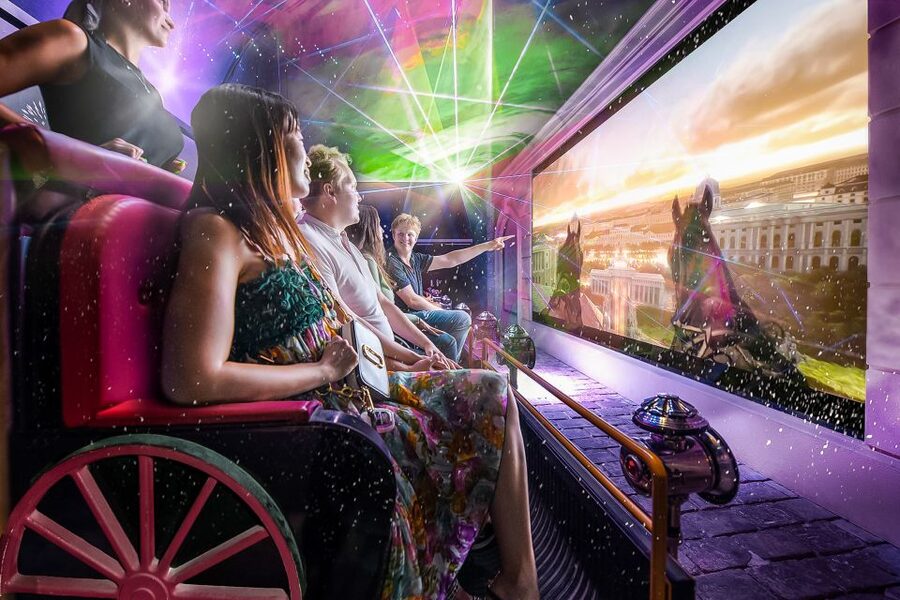
The last sequence is deliberately light. You take a simulated flight over Vienna’s rooftops in a virtual horse-drawn carriage, with the journey ending in the modern city.
It is a cheerful finish after the darker war material. The ride gives you a broad visual look at Vienna and leaves you with the city’s famous skyline in mind. Some visitors also notice simulated snow during the final moments, adding one more theatrical touch.
Do not expect a real panoramic viewpoint. This is a digital ride, not a substitute for climbing a tower or taking a city walk. Its value is that it wraps the story together and sends you back into the streets with a basic mental map of Vienna’s past and present.
The ending also makes the attraction feel suitable for mixed-age groups. Younger visitors get a ride, while adults get a final visual recap of the city they are about to explore.
Why the one-hour format offers good value
At $27 per person, Vienna Time Travel is not the cheapest way to spend an hour in the city. It is also not priced like a full-day museum or a guided walking tour. The value depends on what you want from the visit.
You are paying for several different formats in one ticket: entry to the attraction, a multilingual audio guide, the staged rooms, the 5D cinema, VR, and the final simulated flight. If you tried to recreate the same variety through separate activities, you would spend much more time and probably more money.
The strongest value comes for families and short-stay visitors. One hour is long enough to cover a lot, but short enough to fit between sightseeing stops. Children do not need to manage a long lecture, and adults get a usable introduction to Vienna.
It also works well in poor weather. The attraction is indoors, close to major old-town sights, and easy to pair with the Hofburg or Stephansplatz. Several visitors felt it was worth doing on the first day because it gave them background for the rest of their visit. I agree with that timing advice.
The value is weaker if you already know Vienna’s history well or dislike staged effects. You may find the treatment too simplified, and the short film may leave you wanting more detail. In that case, spend the $27 on a serious museum, a concert, or another activity better matched to your interests.
Location, timing, and the practical details
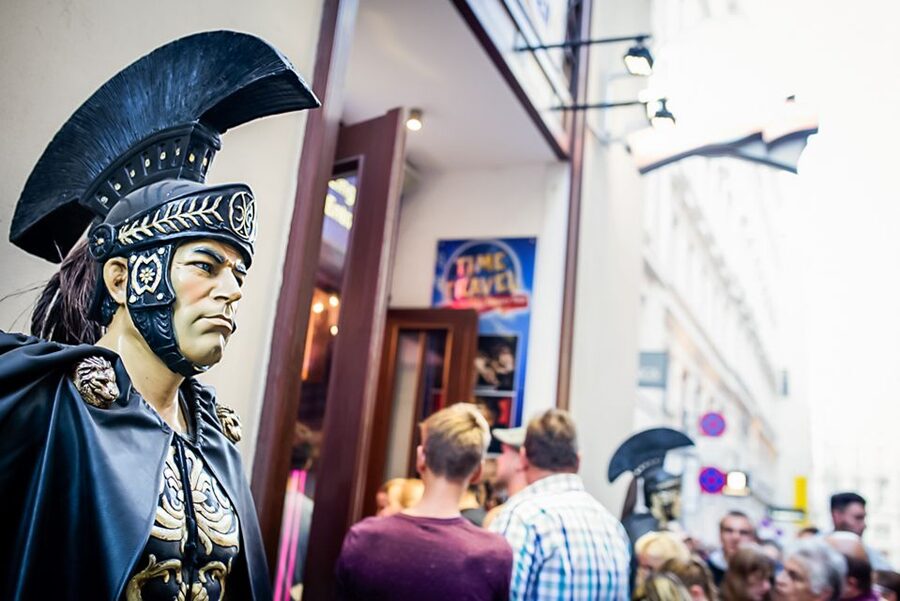
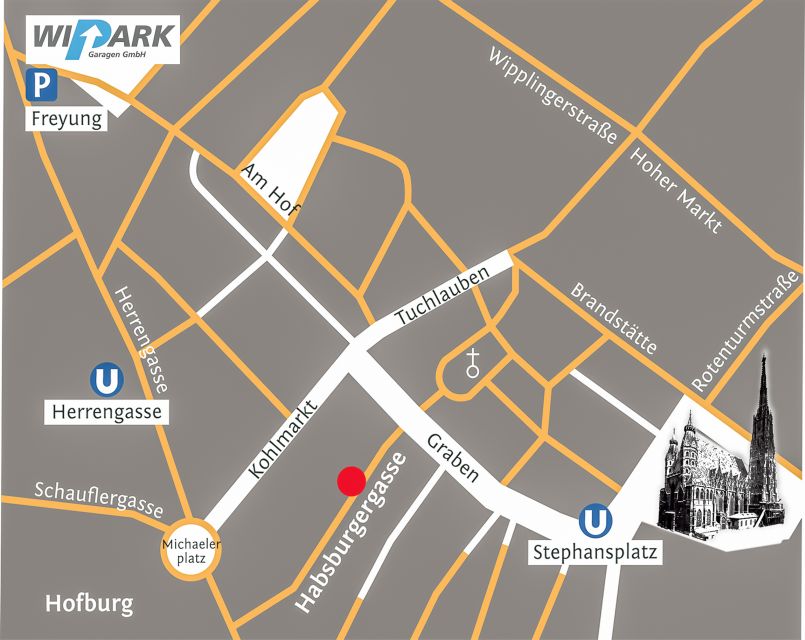
The entrance is at Habsburgergasse 10A in Vienna’s historic center. It is about 200 meters from the Hofburg and roughly 100 meters from Graben, Kohlmarkt, and Stephansplatz, so you can fit it neatly into an old-town sightseeing day.
The nearest underground stops are Stephansplatz on U1 and Herrengasse on U3. If you are driving, discounted parking is available at the Freyung garage. For most visitors, public transport or walking will be simpler because the attraction is in the central pedestrian sightseeing area.
The total duration is one hour. Starting times vary, so check availability before booking. Reservations are strongly recommended, and last admission is at 19:00, so do not arrive at the end of the day assuming you can walk in.
You receive a multilingual audio guide. This makes the experience workable for international visitors, including English speakers. The tour is led through the rooms by staff, and the staff has been described as friendly and helpful. No individual guide names are provided, so do not book this expecting a personal historian with a named presentation.
Video recording is not allowed, and pets are not permitted. Those rules make sense in a small, technology-heavy attraction, but they are worth knowing before you arrive.
The access issue is significant. There is no elevator, and the route includes two levels with about 50 steps. Because of the historic building and legal restrictions, wheelchair users cannot be accepted. People with mobility impairments should consider the nearby Sisi’s Amazing Journey attraction instead, which is located across from Time Travel.
There may also be limited seating during the route. If you are a senior visitor or find standing difficult, ask staff about the available seating when you arrive. The experience is only an hour, but it is still worth planning around your comfort.
Who should book Vienna Time Travel
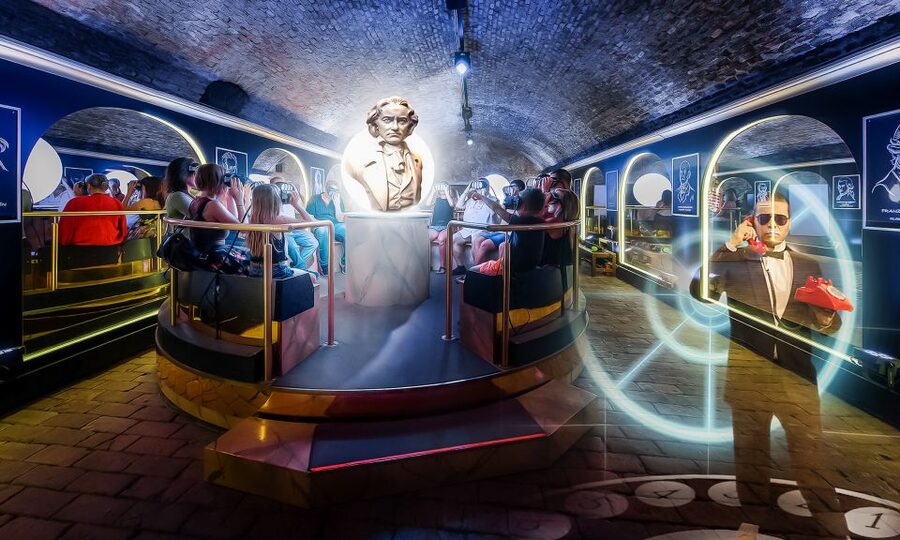
I would recommend it most strongly to families with school-age children, first-time visitors, and adults who learn better through pictures, movement, and sound than through long museum labels. The variety of rooms makes it easy to stay involved, and the short running time fits neatly into a busy day.
It is also a smart choice if the weather is poor or if you want a low-effort activity near the Hofburg. You can follow it with the Sisi attraction across the street, an option several visitors found useful for building a fuller imperial-Vienna afternoon.
Couples and solo visitors can enjoy it too, especially if they want a quick overview before exploring more serious historical sites. I would simply set expectations correctly: this is a theatrical history show with educational content, not a scholarly museum.
Use caution if you dislike darkness, loud effects, VR equipment, or wartime scenes. The plague sequence and bomb shelter section may feel more intense than the cheerful palace scenes. Anyone with mobility limitations should not book without first considering the 50 steps and lack of elevator access.
My verdict on the Vienna Time Travel tour
Book it if you want a lively one-hour introduction to Vienna and like the idea of learning through sets, film, sound, VR, and physical effects. The strongest parts are the changing rooms, the music VR, the imperial family presentation, the wartime shelter, and the moving return-to-freedom scene.
Skip it if you want a slow, detailed, traditional history visit, or if stairs are a problem. At $27, it offers fair value when you use it as a starting point for the city rather than as your only history lesson.
My practical pick is to schedule it early in your Vienna stay, then visit the Hofburg or Sisi’s Amazing Journey afterward. You will leave with names, periods, and images in your head, which makes the city’s grand buildings easier to understand.
FAQ
How long does Vienna Time Travel last?
The experience lasts one hour. Check the available starting times when booking, and note that last admission is at 19:00.
What is included in the ticket?
Your ticket includes entry to the attraction and a multilingual audio guide.
Where is Vienna Time Travel located?
The meeting point is Habsburgergasse 10A in Vienna’s 1010 district. It is about 200 meters from the Hofburg and about 100 meters from Graben, Kohlmarkt, and Stephansplatz.
How do I reach the attraction by underground?
You can use U1 to Stephansplatz or U3 to Herrengasse. Drivers can use the Freyung parking garage, where reduced parking rates are available.
Is the attraction wheelchair accessible?
No. The route covers two levels with about 50 steps, there is no elevator, and wheelchair users cannot be accepted because of the historic building’s structural and legal restrictions.
Can I cancel my booking?
You can cancel up to 24 hours in advance for a full refund. The activity also offers a reserve-now, pay-later option.
Just added around Vienna
- Ottakringer Brewery tour★ 4.0 · 6 reviews
- New Hofburg Palace Tour House of Habsburg★ 4.5 · 5 reviews
- Private Van & Walk Tour – One Perfect Day in Vienna★ 5.0 · 21 reviews
- True Crime mobile puzzle rally Vienna★ 4.0 · 3 reviews
- Vienna Naschmarket Food Tasting Tour★ 4.0 · 30 reviews
- Vienna Nightlife Experience: Food, Wine, Cocktails & Vibes★ 5.0 · 119 reviews
- Myth Mozart★ 4.0 · 80 reviews
- ( Night Tour ) With Private Guide + wine or prosecco★ 4.0 · 12 reviews
Historical Tours, compared.
Vienna Historic Center Small Group Walking Tour
Read our review →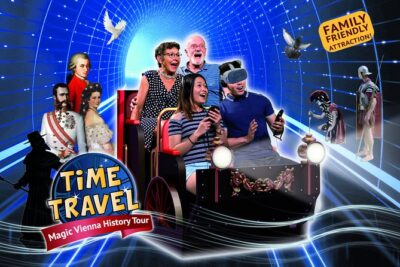
Skip-the-Line Schonbrunn Palace Guided Tour and Vienna Historical City Tour
Read our review →
Vienna Mozart Concert in Historical Costumes at the Musikverein
Read our review →
Browse the lists this tour appears in