
Reviewed · HISTORICAL TOURS
Historical Hitler Walking Tour of Vienna
Hitler’s Vienna is not a tour of grand Nazi monuments. It is a walk through the city where art, politics, antisemitism, and personal ambition collided. You begin at the Vienna State Opera and finish near the Stadttempel Synagogue, passing memorials and public squares that reveal how Austria changed before, during, and after the Second World War.
I like the way the tour connects Hitler’s early years with the wider story of Vienna. I also like the stops at Jewish memorials, especially Judenplatz and Morzinplatz, which keep the tour focused on real victims rather than only on Hitler himself.
The main drawback is the title. One three-star assessment found it too broad for a tour called Historical Hitler Walking Tour. That is a fair warning: you will learn about Hitler, but much of the walk explains Vienna’s political and social setting, the Holocaust, and Austria’s wartime role.
Key points to know before booking
- The walk covers about 2.5 hours, with roughly ten minutes at each major stop and additional walking between them.
- It begins outside the Albertina Museum at 2:30 p.m. and ends near Schwedenplatz, close to U1 and U4 stations and many restaurants.
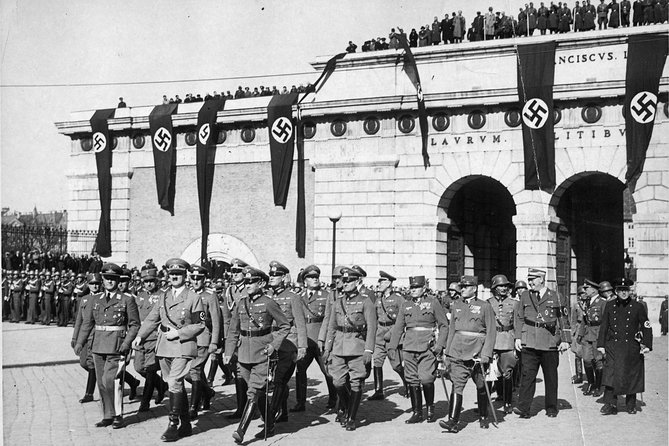
- The State Opera, Heldenplatz, and the Academy of Fine Arts show how Vienna shaped Hitler’s early life and public image.
- Judenplatz, Morzinplatz, and the Stadttempel area give the tour its strongest human and moral focus.
- Guides such as Dieter, Wolfgang, Stephan, Charles, and Siggy have been praised for clear English, strong historical detail, and careful pacing.
- Good shoes and weather protection matter. The tour runs outdoors, and winter evenings can be cold.
A serious walk through Hitler’s Vienna
This experience works best as a guided history lesson that happens to move through central Vienna. You are not simply checking off sights. At each stop, the guide explains how a familiar building or square became tied to Austria’s political collapse, the Nazi takeover, or the persecution of Jewish citizens.
The walk is offered in English and is limited to a maximum of 25 people. That is large enough to provide energy but small enough for a guide to keep the group moving together. Still, you should pay attention at the start. The meeting point at Albertinaplatz is busy, and one person reported being left behind when the guide set off too quickly.
The tour costs $32.65 per person. For two and a half hours with a licensed guide, that is a fair price if you want historical explanation rather than a quick look at monuments. You are paying for the links between places, not admission tickets. Every listed stop is viewed from public space, so there are no extra entry fees during the walk.
A few more Vienna trips to weigh up
- Vienna: Time Travel and Magic Vienna History Tour
★ 4.6 · 3,879 reviews - Vienna: World War II Historical Walking Tour
★ 4.8 · 1,772 reviews - Vienna Historic Center Small Group Walking Tour
★ 5.0 · 1,746 reviews
The Vienna State Opera and the collapse of cultural life
Meet outside the Albertina Museum, then walk to the Vienna State Opera. This is a fine opening because it places the story in one of Vienna’s grandest cultural settings.
The opera opened on May 25, 1869, with Mozart’s Don Juan, in the presence of Emperor Franz Joseph and Empress Elisabeth. Before 1938, it represented the imperial city’s love of music and theater. After the Anschluss, Austria’s annexation by Nazi Germany, the same institution became part of a controlled and damaged cultural world.
Hitler visited the opera in 1938. During the National Socialist period, artists and staff members were forced out, persecuted, or murdered. Some works could no longer be performed. The guide uses this stop to show that the Nazi takeover was not only about government offices and uniforms. It also reached into orchestras, stages, schools, museums, and daily cultural life.
I find this a useful beginning because the opera is easy to admire without knowing its darker associations. You get both sides of the building: the beauty of Vienna’s artistic tradition and the speed with which that tradition could be bent to political power.
The stop lasts about ten minutes. The real value comes from the explanation, since admission to the opera is not included and the tour does not take you inside for a performance.
The Memorial Against War and Fascism
At Albertinaplatz, the Memorial Against War and Fascism offers a direct change in mood. Created by Austrian sculptor Alfred Hrdlicka, the memorial has been in place since 1988 and is dedicated to victims of war and fascism.
This is not a polished imperial monument. Its rough, disturbing forms are meant to unsettle you. The guide explains why a modern Austrian memorial was needed decades after the war, and how public remembrance changed over time.
The stop also helps explain Austria’s difficult postwar story. For years, many Austrians preferred to present the country as Hitler’s first victim. The memorial pushes you toward a less comfortable view of responsibility and suffering.
Allow about ten minutes here. You will likely hear more than a list of dates. Guides have been praised for connecting the sculpture to the way Austria remembered, or failed to remember, the period after 1945.
The art school that rejected Hitler
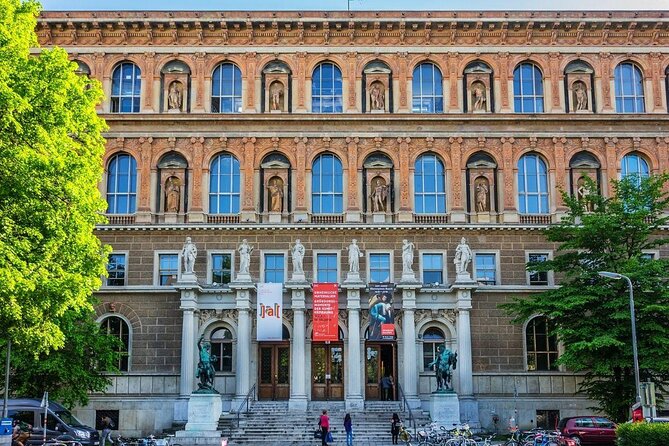
The Academy of Fine Arts is one of the tour’s most recognizable Hitler connections. Hitler applied to the academy and was not accepted. The guide places that event within his early years in Vienna and explains why the city mattered to his developing outlook.
You should keep this stop in proportion. The academy’s rejection did not single-handedly create Hitler’s later politics, and a good guide will avoid making that claim. The useful point is that Vienna was where he lived, struggled, formed views, and encountered the political currents that later shaped his public life.
This is also where the tour’s title makes the most sense. You are walking through places associated with his time in the city, but the focus is not a dramatic recreation of his life. It is a discussion of the environment around him.
The stop lasts about ten minutes. You view the building from outside, and the guide may use maps or images to add context. Stephan has been praised for bringing an iPad with photographs and maps, a helpful touch when the present-day street looks very different from the early twentieth-century setting.
Same Alps, a completely different kind of day:
- Vienna: Vivaldi’s Four Seasons Concert in Karlskirche
★ 4.7 · 14,951 reviews - Vienna: Spanish Riding School Training
★ 3.9 · 9,281 reviews - Vienna: Skip-the-cashier-desk-line Giant Ferris Wheel Ride
★ 4.5 · 7,859 reviews - Vienna: Schönbrunn Palace & Gardens Skip-the-Line Tour
★ 4.7 · 7,739 reviews
Heldenplatz and the March 15, 1938 speech
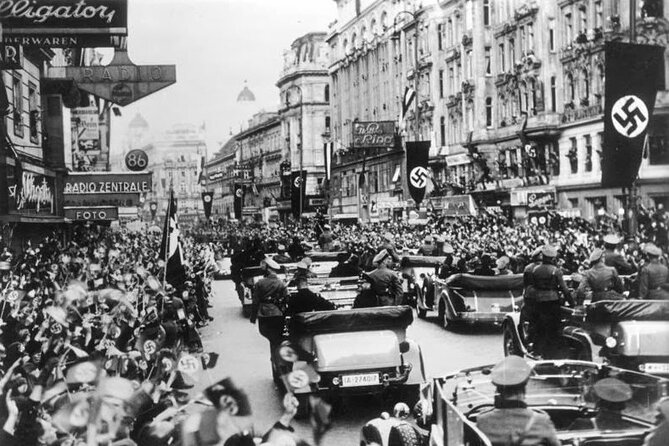
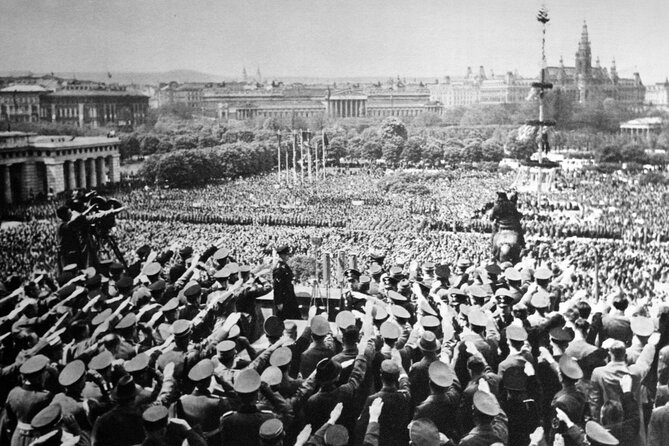
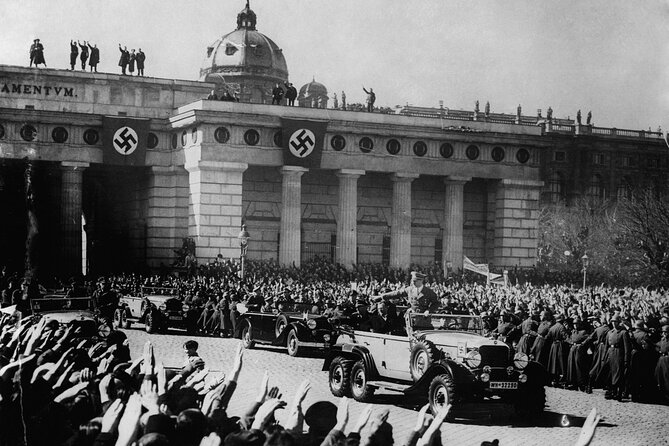
Heldenplatz is perhaps the most powerful public setting on the route. On March 15, 1938, Hitler addressed a huge crowd from the balcony of the Neue Hofburg after the annexation of Austria.
The square had already been used for imperial ceremony. In 1938, it became the backdrop for a mass display of support for the Nazi seizure of power. The guide discusses the speech, the crowd, and the lasting trauma attached to the place in Austria’s postwar memory.
You may know the famous photograph or film footage of Hitler speaking from the balcony. Seeing the broad square in person gives that image a physical scale. It also makes clear why public spaces matter in political history. The setting was not incidental. It helped turn power into spectacle.
Heldenplatz is a strong stop for anyone interested in propaganda and mass politics. It is also a place where the guide’s skill matters. The subject calls for precision, since the crowd’s response, Austria’s political situation, and later national memory all need careful explanation.
Judenplatz and the victims of the Holocaust
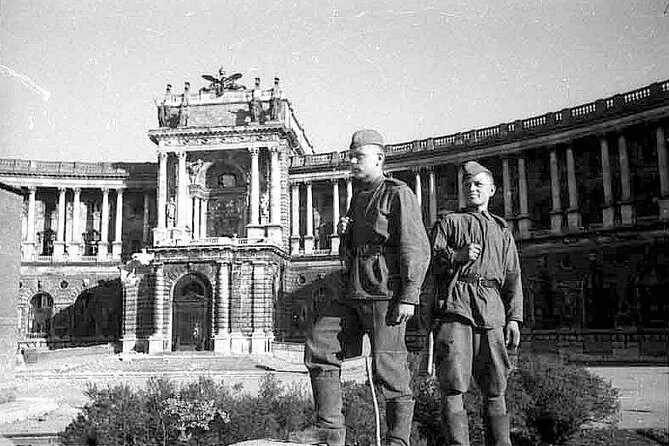
The tour then crosses the historic center toward Judenplatz. Here, the focus moves from Hitler’s personal story to Vienna’s Jewish population and the people murdered under National Socialism.
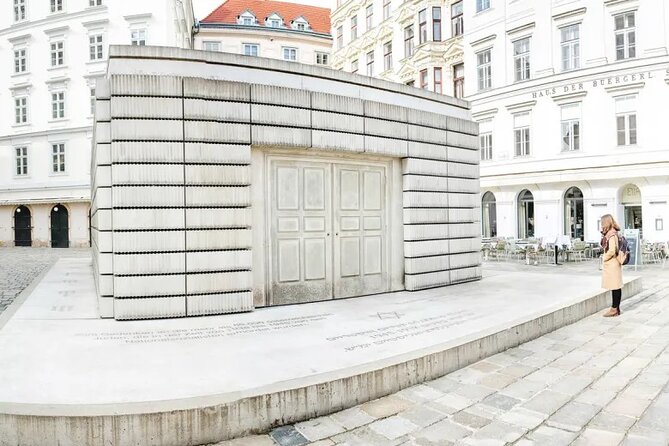
The Holocaust memorial at Judenplatz commemorates more than 65,000 Austrian Jews killed between 1938 and 1945. Its design suggests a sealed library, with rows of books turned outward and no readable titles. It is a quiet, heavy place, and the guide gives you time to understand what the number represents.
This is one of the most important stops because it prevents the walk from becoming a biography of a dictator. Hitler’s name may draw you to the tour, but the memorial redirects attention to the people whose lives were destroyed.
The guide may also discuss the Jewish community’s size and importance in Vienna before the Holocaust, as well as the persecution that followed the Anschluss. The supplied route description specifically emphasizes Jewish architecture that survived the Holocaust, so you are seeing both memorials and traces of a community that once shaped the city.
Judenplatz is free to visit, but the emotional cost of the subject is real. You should not expect light sightseeing here. It is a place for quiet attention.
Morzinplatz and the former Hotel Metropole
At Morzinplatz, the guide explains the site of the former Hotel Metropole. What had been a luxury hotel became one of the most brutal Gestapo headquarters in the Third Reich.
The present memorial marks the location and recalls those who were imprisoned, tortured, and persecuted there. This stop shows how Nazi power used existing city buildings. Terror did not happen only at distant camps or battlefields. It was organized from offices inside an ordinary urban center.
Morzinplatz also adds an important local scale to the tour. You are no longer looking at a famous speech or a grand opera house. You are standing where police power operated against Vienna’s residents.
The visit lasts around ten minutes. Since the former hotel is gone, the guide’s storytelling carries much of the stop. This is another reason to choose a well-prepared guide rather than expecting a large structure to explain itself.
The Stadttempel and Vienna’s hidden synagogue
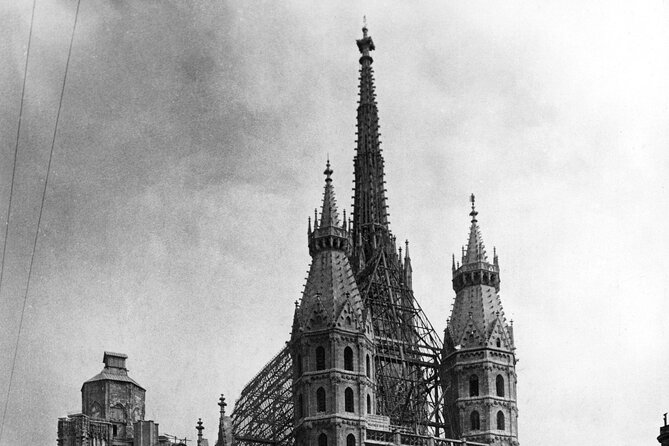
Near the end, the walk reaches the Jewish Vienna information point and the area around the Stadttempel, Vienna’s main synagogue. The synagogue is at Seitenstettengasse 4, behind a five-story apartment building rather than facing the street openly.
This arrangement dates to regulations that required non-Catholic places of worship to remain hidden from direct street view. The building’s position is a reminder of older religious restrictions, long before the Nazi period, and it adds another layer to Vienna’s history of exclusion.
The entrance carries the inscription, Come to his gates with thanksgiving, to his courts with praise. The synagogue survived the Holocaust and remains an important Jewish institution in Vienna.
You do not enter the synagogue as part of this walking tour. Instead, the guide explains why it is concealed and points out the surrounding architecture. That makes this a thoughtful final stop. It links the city’s earlier religious rules to the later destruction of Jewish life, while also showing survival and continuity.
What the guides add to the experience
The strongest part of this tour is the guide. Several guides have led it, including Dieter, Wolfgang, Stephan, Charles, and Siggy. Dieter is especially praised for well-organized explanations, care with the group, and a relaxed pace. Wolfgang is noted for a philosophical approach and strong historical detail. Stephan has used an iPad with maps and photographs to make past events easier to picture.
The English delivery has generally been praised, though one person found it difficult to hear at times through the audio device. If you are hard of hearing, stay near the guide and ask to be positioned where you can follow clearly.
The best guides do more than recite dates. They explain how Vienna’s imperial culture, antisemitism, political unrest, and Nazi propaganda fit together. They also take questions. That matters on a subject where simple explanations can quickly become misleading.
You should also expect some variation between guides. The names above are examples of guides who have led the experience, not a guarantee that one particular person will lead your departure.
Walking conditions, timing, and group size
The tour begins at 2:30 p.m. and lasts about two hours and thirty minutes. It ends near Schwedenplatz, just a few minutes from U1 and U4, with restaurants nearby for a meal afterward.
The route is through central Vienna and requires moderate physical fitness. Wear comfortable shoes and clothes. You will be outside for much of the afternoon, with no food or drinks included, so carry water.
Vienna’s weather can change quickly. Bring sunscreen and a raincoat or umbrella in warmer months, and dress warmly in winter. Cold weather has been a repeated concern, although guides have sometimes added indoor pauses so the group could warm up.
Because the tour depends on good weather, a poor forecast can lead to a new date or a full refund. You can also cancel for a full refund up to 24 hours before the start time. The activity requires a minimum number of bookings, so a cancellation for that reason brings the same choice of another date or a full refund.
Who should book this Vienna history walk?
This is a strong choice for history buffs, especially if you want Austria’s role explained rather than receiving a broad Second World War tour. It suits you if you enjoy political history, Jewish history, memorials, architecture, and careful discussion of how public memory changes.
It is also useful early in a Vienna visit. The route passes major landmarks such as the opera and Heldenplatz, while the guide points out less familiar sites you might otherwise walk past. Take notes on recommendations for other places to visit, since the guide may help you see the center with better context afterward.
You should skip it if you want a fast overview of Vienna’s palaces, music, and food. You should also reconsider if you expect every minute to focus directly on Hitler. The tour is inspired by the idea of Hitler’s Vienna, but its wider subject is the city and society around him.
Should you book the Historical Hitler Walking Tour?
Book it if you want a serious, well-paced look at Vienna’s connection to Hitler, the Nazi takeover, Jewish persecution, and Austria’s difficult wartime memory. At $32.65, the cost is reasonable for a licensed English-speaking guide and a two-and-a-half-hour route with several meaningful sites.
Go prepared for a long outdoor walk and emotionally difficult material. Wear sensible shoes, arrive early at Albertinaplatz, and keep close to the guide once the group moves. If those conditions suit you, this tour offers far more than a Hitler biography. It gives you a clearer understanding of how Vienna’s beautiful public spaces became settings for exclusion, propaganda, terror, remembrance, and survival.
FAQ
Where does the Historical Hitler Walking Tour begin?
The tour begins at Albertinaplatz, outside the Albertina Museum in central Vienna.
What time does the tour start?
The stated start time is 2:30 p.m.
Where does the tour finish?
It ends near Schwedenplatz, a short walk from the U1 and U4 lines and restaurants.
How long does the walking tour last?
The tour lasts approximately two hours and thirty minutes.
What language is the tour offered in?
The tour is offered in English.
What is included in the price?
A licensed and well-informed guide is included. Food, drinks, hotel pickup, hotel drop-off, and optional gratuities are not included.
How much walking ability do I need?
You should have a moderate level of physical fitness and wear comfortable shoes and clothing.
Is the tour suitable in bad weather?
The experience requires good weather. If it is canceled because of poor weather, you will be offered another date or a full refund.
Can I cancel the booking?
Yes. You can cancel up to 24 hours before the start time for a full refund. Changes or cancellations made less than 24 hours before the start time are not accepted for a refund.
Just added around Vienna
- Ottakringer Brewery tour★ 4.0 · 6 reviews
- New Hofburg Palace Tour House of Habsburg★ 4.5 · 5 reviews
- Private Van & Walk Tour – One Perfect Day in Vienna★ 5.0 · 21 reviews
- True Crime mobile puzzle rally Vienna★ 4.0 · 3 reviews
- Vienna Naschmarket Food Tasting Tour★ 4.0 · 30 reviews
- Vienna Nightlife Experience: Food, Wine, Cocktails & Vibes★ 5.0 · 119 reviews
- Myth Mozart★ 4.0 · 80 reviews
- ( Night Tour ) With Private Guide + wine or prosecco★ 4.0 · 12 reviews
Historical Tours, compared.
Vienna Historic Center Small Group Walking Tour
Read our review →
Skip-the-Line Schonbrunn Palace Guided Tour and Vienna Historical City Tour
Read our review →
Vienna Mozart Concert in Historical Costumes at the Musikverein
Read our review →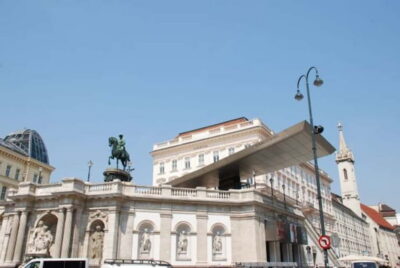
Browse the lists this tour appears in