
Reviewed · WALKING TOURS
Private Introduction to Vienna Walking Tour
Vienna’s story comes in layers, and this private three-hour walk connects them neatly. You move from the Hofburg and Habsburg burial traditions to Ottoman sieges, Nazi-era memorials, modern architecture, and present-day Austria. It is a smart first-morning introduction, especially if you want the city to make sense before exploring on your own.
I like the one-guide-for-your-group format, which lets you ask questions and set a comfortable pace. I also like the range of sights, from the grand Stephansdom to the Loos House, old city walls, Belvedere, Naschmarkt, and MuseumsQuartier. The drawback is the price for a small party: $566.25 is fair for a full group of 10, but steep for just two people, and the walk does not include food, drinks, or stated interior admissions.
Key points to know before booking
- The route covers Vienna’s central story: Hofburg, Graben, Stephansdom, Habsburg burial sites, the old walls, Ringstrasse, Belvedere, Naschmarkt, and MuseumsQuartier.
- Your guide is an historian: Guides named in past bookings include Katarina, Selin, Biljana, and Else, though your assigned guide may differ.
- The private format matters: Only your group participates, with space for questions, family needs, and a custom pace.
- The price favors larger groups: At the maximum of 10 people, the cost works out to about $56.63 per person. For two, it is about $283.13 each.
- Start at Cafe Hawelka: Meet 15 minutes early at Dorotheergasse 6 unless hotel pickup has been arranged.
- Plan for a long city walk: The tour lasts about three hours and covers many districts and landmarks, so comfortable shoes are a sensible choice.
A strong first look at Vienna’s many pasts
This tour works because it does not treat Vienna as only an imperial city. You see the Habsburg palace, but you also hear about architecture that challenged old styles, wars that changed the city, religious traditions, the Soviet role in Vienna’s liberation, and modern Austria’s political and cultural direction.
That mix gives you useful context for the rest of your stay. After three hours, you should have a better sense of how the old center fits together and which places deserve a return visit. You also get a practical orientation to the Innere Stadt and several areas just beyond it.
The tour is conducted in English and is private. That is important in a city where a fixed group tour can feel rushed around crowded central sights. Your guide can pause at a building that interests you, explain a question from a child or young adult, or adjust the balance between art, religion, politics, and imperial history.
Past guide names include Katarina, Selin, Biljana, and Else. The descriptions of those walks point to a friendly, energetic approach, with special praise for clear storytelling, a comfortable pace, and customized attention. Guide assignments can change, so you should not book on the assumption that one particular person will lead your walk unless the provider confirms it.
A few more Vienna trips to weigh up
- Vienna: Guided Walking Tour of City Center Highlights
★ 4.7 · 4,989 reviews - Vienna: Vienna Central Cemetery Guided Walking Tour
★ 4.8 · 3,307 reviews - Vienna: Guided Walking Tour of City Highlights & Hidden Gems
★ 4.9 · 2,180 reviews
Starting beneath the Hofburg at Michaelerplatz
The usual meeting point is Cafe Hawelka on Dorotheergasse 6, in Vienna’s first district. You are asked to meet your guide 15 minutes before the start. Hotel pickup is offered if arranged in advance, which can make the opening easier if you are still finding your way around Vienna.
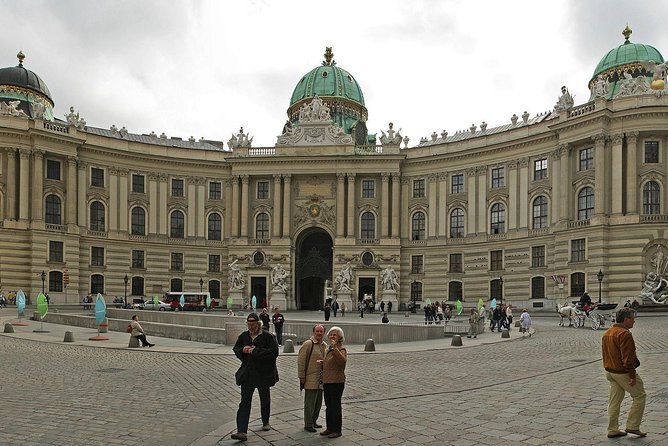
From there, the route begins at Michaelerplatz, one of the best places to see Vienna’s competing eras in a single glance. The Hofburg dominates the square. This was the Habsburg imperial palace and seat of power from the thirteenth century onward, and its size helps explain how strongly the dynasty shaped the city.
The useful point here is not simply that the Hofburg is grand. It is that Vienna’s center grew around power, ceremony, religion, and court life. Your guide can give those layers a human scale before you spend time in the palace museums or other imperial sights later.
Michaelerplatz also gives you an early contrast with the green and gray Loos House. Designed by Adolf Loos, who lived from 1870 to 1933, the building became an important break from the more decorated style associated with imperial Vienna. Its plain exterior can seem almost startling beside the Hofburg.
I like this opening because it puts old and new architecture side by side right away. You are not just looking at a palace and taking a photograph. You are seeing a city argue with its own past through buildings.
Kohlmarkt, Graben, and the center’s grand public spaces
The walk continues along Kohlmarkt and the Graben, now among Vienna’s most fashionable shopping streets. These streets can be busy, so your guide’s commentary is especially useful when the visual setting becomes crowded and noisy.
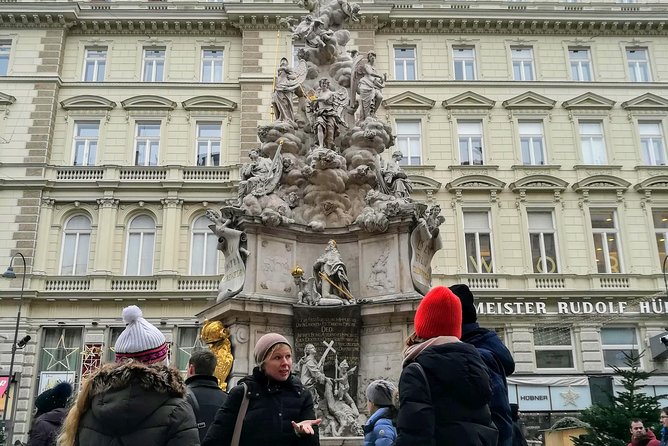
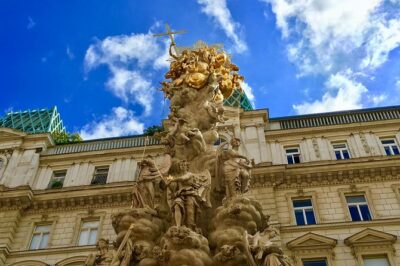
The Graben brings together several important themes. You see grand buildings in different styles, the ornate plague column, and a baroque church. The plague column recalls the devastating epidemic that shaped public life and religious expression, while the surrounding architecture shows how Vienna rebuilt and represented itself over time.
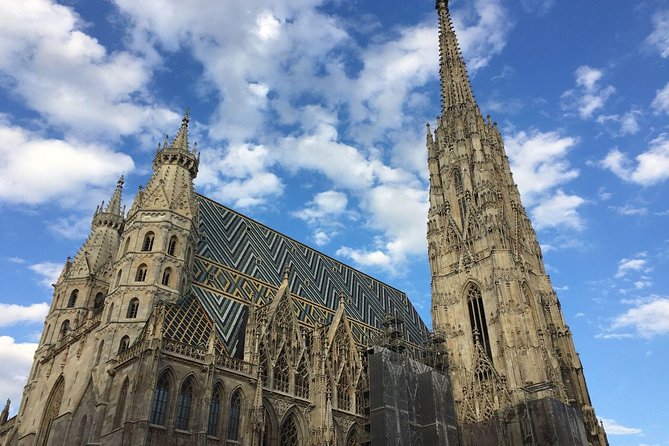
The route then reaches Stephansdom, Austria’s national architectural icon. The cathedral is one of the city’s clearest visual markers, and it helps you understand Vienna’s medieval core. The walk’s value here is the link between the cathedral and the Habsburg family rather than simply a quick stop for exterior photographs.
Keep in mind that this is a walking history tour, not a cathedral admission tour. The information provided does not promise entry to Stephansdom or other interiors. If you want to climb a tower, visit a museum collection, or see a specific room inside the Hofburg, set aside separate time and confirm admission details independently.
The Habsburgs and their unusual three-part burials
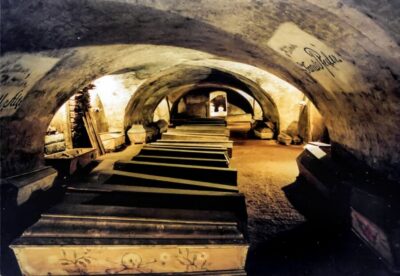
One of the more distinctive sections explains the Habsburg custom of separating the body, heart, and entrails for burial. Vienna connects these traditions through three religious sites.
St. Stephen’s Cathedral holds the imperial entrails. The nearby Capuchin Church contains the sarcophagi of generations of Habsburg rulers. St. Augustine’s Church has silver urns holding the family hearts.
That detail gives the dynasty a surprisingly physical presence in the city. Instead of thinking of the Habsburgs only as portraits in palaces, you see how their family rituals occupied separate churches within the central city.
The Capuchin Church is described as humble, a useful contrast to the elaborate imperial image. The silver heart urns at St. Augustine’s offer another angle on the family’s religious customs. These stops may appeal most to you if you enjoy dynastic history, church architecture, or the strange details that make European history memorable.
Again, do not assume that the three-hour walk includes entry to all three churches. The route takes in the sites and explains their importance, but the supplied details list only the private guided walk as included.
Same Alps, a completely different kind of day:
- Vienna: Vivaldi’s Four Seasons Concert in Karlskirche
★ 4.7 · 14,951 reviews - Vienna: Spanish Riding School Training
★ 3.9 · 9,281 reviews - Vienna: Skip-the-cashier-desk-line Giant Ferris Wheel Ride
★ 4.5 · 7,859 reviews - Vienna: Schönbrunn Palace & Gardens Skip-the-Line Tour
★ 4.7 · 7,739 reviews
From medieval walls to the Ringstrasse
Along the edge of the inner city, you examine surviving pieces of Vienna’s old walls. These defenses date from the twelfth century and helped protect the city during Ottoman sieges in 1529 and 1683.
The walls also explain one of Vienna’s biggest urban changes. They were eventually removed to make room for the Ringstrasse, the wide circular boulevard that became Vienna’s answer to the grand boulevards of Paris. This is a good example of how the tour links military history with city planning.
You may find this section especially helpful if you plan to walk the Ringstrasse later or visit its museums and monumental buildings. The guide gives you a reason for the boulevard’s scale instead of leaving it as a string of impressive façades.
The route continues to Schwarzenbergplatz, where a large fountain and memorial honor Soviet soldiers who died liberating Vienna from the Nazis. The monument can prompt difficult questions about memory and politics, since the Soviet presence shaped Austria’s postwar years as well as its liberation.
The square is also near many embassies, giving the stop a diplomatic and modern side. I appreciate that the route does not end its history lesson with the Habsburgs. Vienna’s twentieth-century experience gets a place in the story.
The Belvedere detour and the view toward Karlsplatz

The walk makes a quick detour toward Belvedere Palace before heading back toward Karlsplatz. The palace is one of Vienna’s best-known landmarks, but the tour information does not promise a palace visit or art collection entry.
That makes this stop more useful for orientation than for a full museum experience. Your guide can place Belvedere within the city’s sequence of palaces, gardens, boulevards, and cultural institutions. If you want to visit the interiors or see the famous art displays, plan another visit and allow extra time.
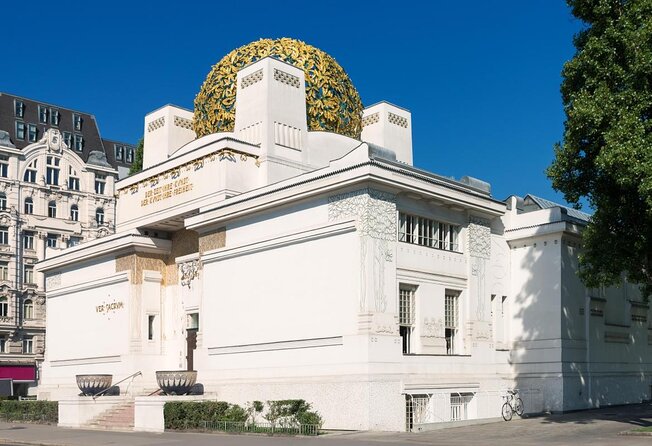
From the Karlsplatz area, you get a view of one of the gold-domed Secession buildings and the Naschmarkt. The Secession building represents Vienna’s modern artistic identity and provides another sharp contrast with the Hofburg’s imperial style.
Naschmarkt adds a more everyday side of the city. The route only promises a view and discussion, not a meal or tasting. Since food and drinks are not included, you should not treat this tour as a market food walk. Still, seeing the market helps you understand how the central city shifts from courtly monuments to shopping, dining, and ordinary urban life.
MuseumsQuartier and Maria Theresien Platz
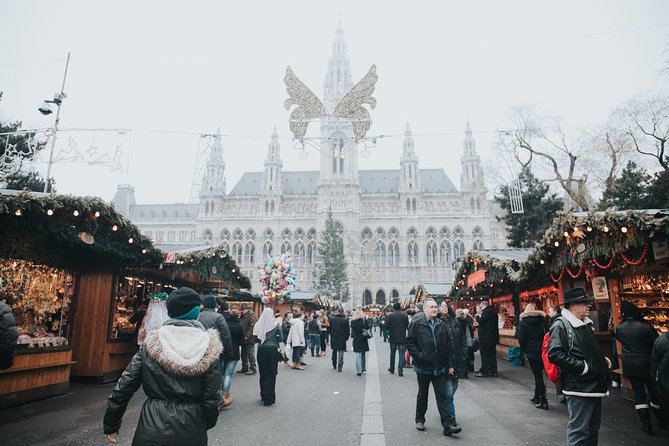
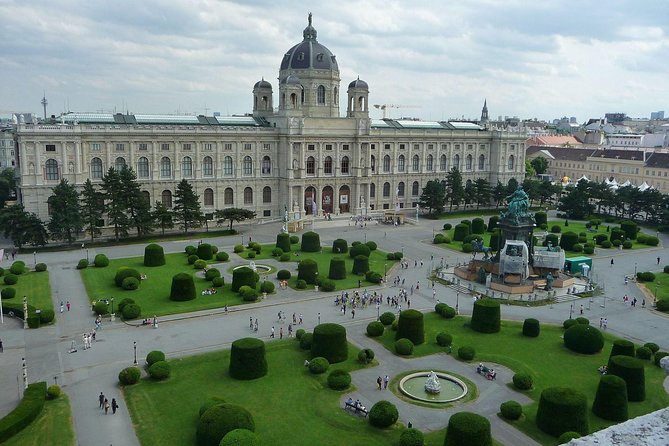
The final section moves through MuseumsQuartier and Maria Theresien Platz, an area with Vienna’s largest concentration of museums. This is a sensible ending because it shifts the focus from what Vienna was to how the capital presents itself today.
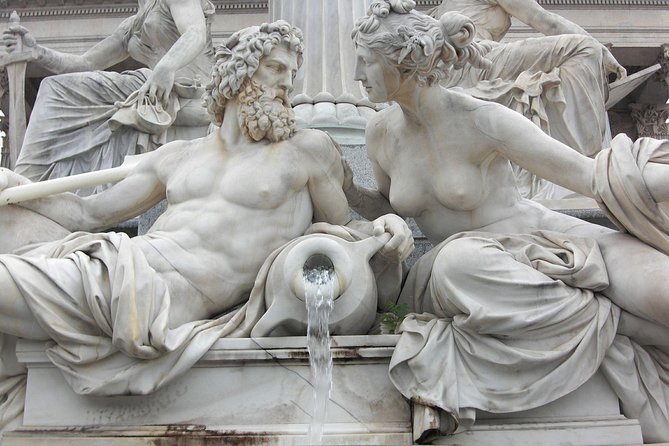
Maria Theresien Platz also brings the Habsburg story back into view through one of the dynasty’s major figures and the monumental setting around the museums. The result is a useful bridge between imperial patronage and modern cultural life.
Your guide also discusses Austria’s present-day cultural, political, and economic direction. That broadens the walk beyond dates and royal names. You get a framework for understanding Vienna as a working capital, not simply an open-air museum.
Three hours is long enough to cover a lot, but not long enough for every stop to receive a full treatment. The benefit is range. The cost is that some landmarks will receive an explanation and exterior look rather than an extended visit.
Why a private guide changes the experience
A private tour is most valuable when you use the freedom it gives you. Ask about the Habsburgs, architecture, religion, wartime Vienna, modern Austria, or anything you notice along the route. You are not waiting for a large group to catch up or listening to questions that do not interest you.
The format also suits families. Biljana was praised for keeping a pace that worked for adults in their twenties, while Selin was described as creating a customized walk for a family. Those details suggest that the tour can work for mixed ages when the guide adjusts the storytelling.
Couples can also benefit from the private arrangement. Else was described as meeting a couple at their hotel, moving efficiently through the city, and covering historical, religious, and cultural sights without making the walk feel hurried. That balance is useful on a first full day, when you want plenty of information but still need time to look around.
The guide is identified as an historian, not simply a route leader. That should appeal to you if you want explanation and context rather than a checklist of photo stops. Still, the experience depends heavily on the guide assigned to your date, so expectations should remain sensible.
Is $566.25 a fair price?
The listed rate is $566.25 per group of up to 10 people. With 10 participants, the cost is about $56.63 per person, which is reasonable for three hours with a private historian guide in a major European capital.
For five people, the math rises to about $113.25 per person. For two people, it is about $283.13 each. At that point, you are paying a large premium for privacy and personal attention, so the decision depends on how much you value a custom walk.
I would consider this strongest for a family or friend group that can share the cost. A group of eight to 10 gets a much better deal than a couple. The private format can also save time because you are not managing strangers, and the route provides a useful map of several central areas in one morning.
There are no food or drinks included. No entry fees are listed as included either, so budget separately if you want to return inside Stephansdom, the Capuchin Church, Belvedere, or a museum. Treat the walk as an orientation and history service, not a ticketed museum package.
Timing, meeting point, and practical comfort
Meet at Cafe Hawelka, Dorotheergasse 6, 1010 Vienna, 15 minutes before the scheduled start unless hotel pickup has been arranged. The listed ending is Vienna, Austria, rather than a precise final address, so ask for the exact endpoint if you need to coordinate a restaurant, train, or museum reservation afterward.
The route covers several central districts and lasts about three hours. Comfortable walking shoes are a practical choice, even though the tour description does not state a total distance. You should also allow flexibility after the tour, since the final sections near MuseumsQuartier can lead naturally to more sightseeing.
Most people can participate, and only your own group joins the activity. Confirmation is received at booking. Free cancellation is available when you cancel at least 24 hours before the start time. Changes or cancellations inside that period are not accepted for a refund.
Who should book this Vienna walk?
I would choose it for a first visit, especially if you want a clear mental map before visiting museums and palaces. It also suits families, couples, and groups who prefer conversation over a fixed script.
It is a good match if you enjoy architecture, dynasties, religious traditions, city planning, and twentieth-century politics in the same outing. The variety keeps the walk from becoming only another Habsburg lecture.
You may want something else if you prefer a short route focused on one museum, a food tour with tastings, or extensive interior visits. This experience moves across a broad section of Vienna, so its strength is connection and context rather than long stops inside individual buildings.
Should you book it?
Book this private walk if you want a personal orientation to Vienna and can share the cost with a larger group. The route covers an unusually broad range of subjects, and the private format gives you room to ask questions and adjust the pace.
For a couple on a tight budget, the price is harder to justify. For a family or group of friends arriving in Vienna for the first time, it can be a sensible way to organize the city quickly, learn which sights deserve more time, and begin your stay with a well-told sense of place.
FAQ
How long is the Private Introduction to Vienna Walking Tour?
The tour lasts approximately three hours.
Where does the tour begin?
Unless hotel pickup has been arranged, meet at Cafe Hawelka, Dorotheergasse 6, 1010 Vienna, Austria.
How early should I arrive?
You should meet your guide 15 minutes before the scheduled start time.
Is hotel pickup available?
Yes. Pickup is offered when hotel pickup has been arranged.
Is the tour private?
Yes. Only your group participates in this activity.
How many people can join the group?
The price covers up to 10 people per group.
What language is the tour offered in?
The tour is offered in English.
Are food and drinks included?
No. Food and drinks are not included unless specifically stated.
Can I cancel for a full refund?
Yes, if you cancel at least 24 hours before the experience start time. Cancellations or changes made less than 24 hours before the start are not accepted for a refund.
Just added around Vienna
- World War II History Vienna Old Town Private Walking Tour★ 4.8 · 9 reviews
- From Krems: Wachau Valley River Cruise on the Danube★ 4.6 · 95 reviews
- Vienna: Winery and Wine Tasting Tour with a Wine Expert★ 5.0 · 5 reviews
- Vienna: Wine Tasting E-Bike Tour★ 4.9 · 46 reviews
- Vienna: Wine Tasting at Schönbrunn Palace★ 4.3 · 71 reviews
- Vienna: Wine Tasting Tour★ 4.8 · 61 reviews
- Vienna: Wiener Schnitzel and Strudel Cooking Class★ 4.9 · 126 reviews
- Vienna Urban Art Tour: Explore a different side of Vienna!★ 3.8 · 14 reviews
Walking Tours, compared.
Guided Walking Tour of City Center Highlights
Read our review →
Guided Walking Tour of City Highlights & Hidden Gems
Read our review →
Vienna Historic Center Small Group Walking Tour
Read our review →
Browse the lists this tour appears in