
Reviewed · WALKING TOURS
Vienna: 1.5-Hour Underground Walking Tour
Vienna’s grandest sights are above ground, but some of its most unsettling stories lie below it. This 100-minute underground walking tour links Roman ruins, old cellars, fragments of the medieval city, and the Baroque crypt beneath St. Michael’s Church. The mummies are the main draw, but the changing layers beneath Michaelerplatz give the tour its real character.
I like the way the tour connects the archaeology to the city you can see above it, and I like the human touch supplied by guides such as Christopher and Bridgett, whose storytelling and humor have earned strong praise. The main consideration is language: the tour is officially in German, with occasional English help rather than a guaranteed full English translation.
Key points at a glance
- Roman remains at Michaelerplatz: See part of Vienna’s ancient settlement exposed during later building work.
- St. Michael’s crypt: Enter a Baroque burial site containing more than 4,000 burials and well-preserved mummies.
- Several underground spaces: The route includes a 17th-century cellar, part of the old city wall, and additional basements.
- German-speaking guides: Christopher and Bridgett are among the guides praised for lively explanations and humor.
- A cool, unusual break from palaces: Bring a sweater, since the crypt and cellars can feel chilly.
- A strong price for a specialist tour: At $32, the entrance fees and unusual access make this good value for history-minded visitors.
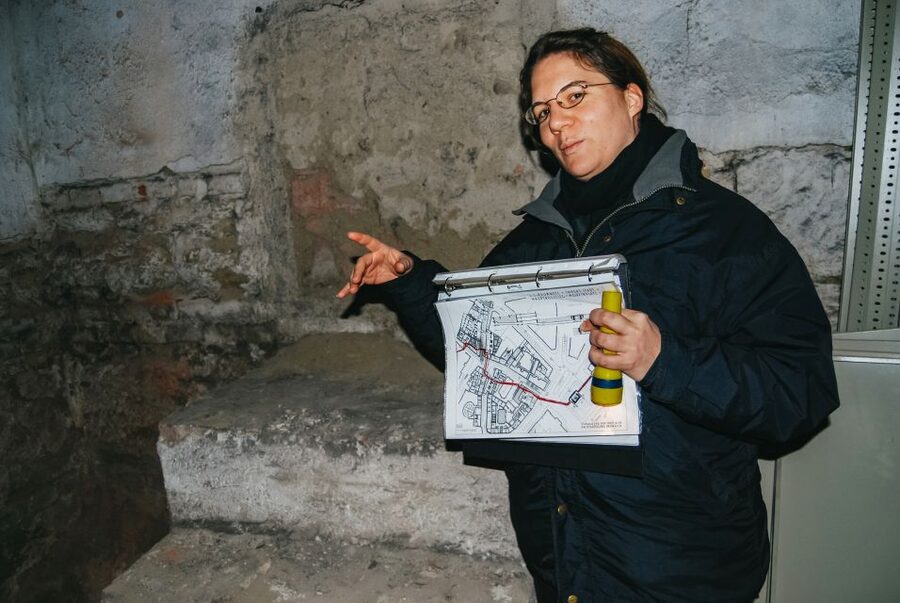
Start at Michaelerplatz, where Vienna goes back 2,000 years
You meet in front of the main entrance to St. Michael’s Catholic Church. That location is handy, since the tour begins close to the Hofburg and in the middle of Vienna’s historic center. You do not need a transfer, taxi, or separate museum admission to reach the starting point.
The first stop is Michaelerplatz, one of those Vienna squares that rewards a closer look. Above ground, you are surrounded by major imperial buildings and city traffic. Below and around the square, archaeological work has revealed pieces of earlier Vienna, including part of the old Roman city.
That contrast is the point. You are not simply entering a dark basement and hearing disconnected facts. You begin with a place where different periods of Vienna sit almost on top of one another. Building work exposed Roman remains, while a 17th-century cellar and a section of the old city wall add later chapters to the same site.
I find this a useful way to begin because it gives you a sense of time before the tour moves indoors. The ruins may not satisfy anyone expecting a large, intact Roman monument. Their value comes from seeing how old Vienna is and how much of the city’s past has been covered, reused, and built over.
Your guide supplies the explanation in German. Guides including Christopher and Bridgett have been praised for adding stories, historical detail, and humor rather than simply pointing at stones. If your German is limited, you can still follow the physical route, but the experience will be much stronger if you understand German well.
A few more Vienna trips to weigh up
- Vienna: Guided Walking Tour of City Center Highlights
★ 4.7 · 4,989 reviews - Vienna: Vienna Central Cemetery Guided Walking Tour
★ 4.8 · 3,307 reviews - Vienna: Guided Walking Tour of City Highlights & Hidden Gems
★ 4.9 · 2,180 reviews
St. Michael’s Church and the Baroque crypt
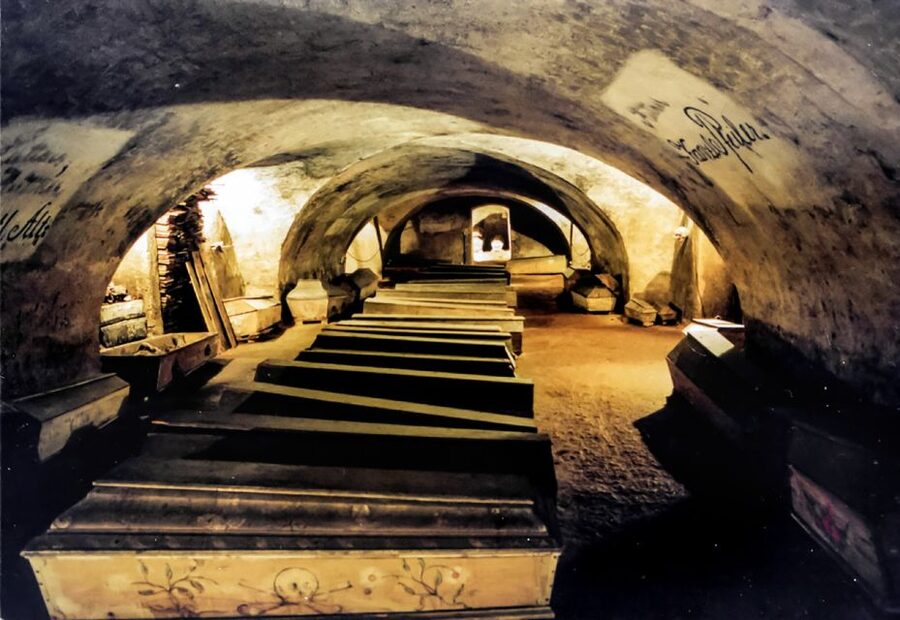
The emotional center of the tour is the crypt beneath St. Michael’s Church. More than 4,000 people were buried here, including prominent and wealthy Viennese citizens. The church’s crypt is not a polished palace museum. It is a burial place, and the mood is appropriately solemn.
The best-known feature is the group of remarkably preserved mummies. Their condition makes the visit memorable, but it also makes the stop more than a quick curiosity. You are looking at physical evidence of past lives, social status, and burial customs. The people below the church were part of Vienna’s civic and religious world, not anonymous figures from a textbook.
You should expect the guide to explain the setting and its history as you move through the crypt. The experience is visual, but the details matter. Without context, preserved bodies can become a shock-value display. With a good guide, the mummies help explain how the crypt was used and why some remains survived in such a striking form.
This is also the part that makes the $32 price easier to justify. You are paying for admission as well as guided access to a place you would not normally find by walking through the city on your own. The crypt alone is likely to be the most memorable stop for many people, especially if you have already seen Vienna’s palaces, concert halls, and grand churches.
Still, this is not an attraction for everyone. The subject is death, the space is underground, and the mummies are real human remains. If you prefer light sightseeing, you may find this stop uncomfortable. For adults interested in religious history, medicine, burial customs, or the less polished side of European cities, it offers something the standard Vienna route does not.
Cellars, walls, and the city beneath the city
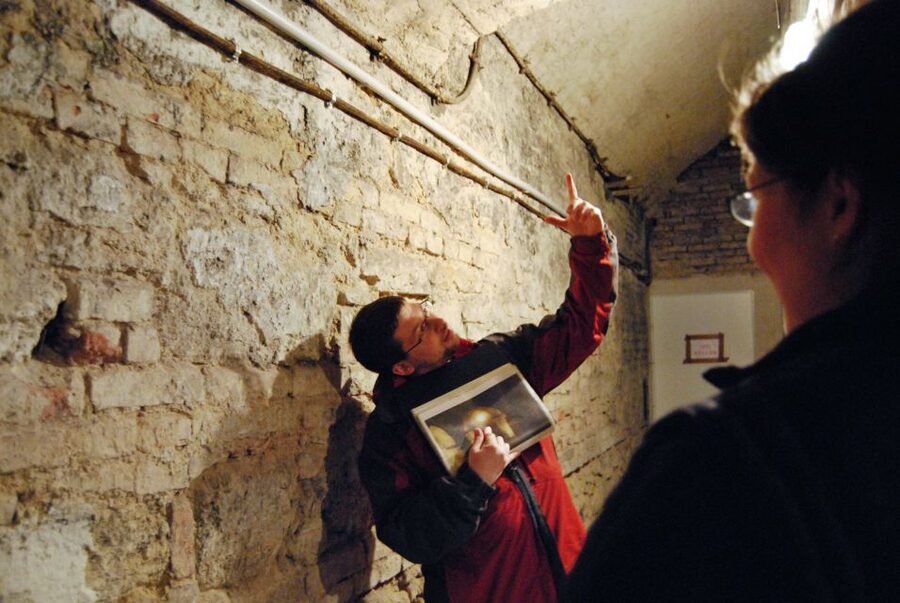
After the crypt, the guide takes you through additional basement areas. The exact feel of these spaces is more practical than theatrical. You are seeing old foundations and underground rooms that formed part of everyday city life, rather than a purpose-built attraction with sets and special effects.
A 17th-century cellar and part of the old city wall help show how Vienna changed as it grew. Cellars were useful storage areas, while defensive walls marked the limits of the city. Today, these remnants are easy to miss because modern streets and buildings cover them.
The tour’s route is one of its strengths. You get more than a single crypt visit, but you should also keep your expectations realistic. The experience does not take you through an enormous maze of tunnels. One earlier assessment found that the tour focused on a few rooms and did not go much farther into the underground passages.
That limited access is not necessarily a flaw. Underground archaeology is often fragile, restricted, or divided between private and public spaces. The value here is being allowed into several otherwise closed areas and having a guide explain what you are seeing. If you want a long tunnel expedition, this may feel modest. If you want a compact look at hidden foundations in central Vienna, the format works well.
One person reported that the tour lasted close to three hours, although the stated duration is 100 minutes. You should plan around the official length, while allowing a little extra time in case the guide takes longer with questions or stories. A 100-minute visit fits neatly into a day of sightseeing without consuming half your afternoon.
What the guide adds to the underground spaces
This tour depends heavily on the guide. Dark rooms, old walls, and mummies need explanation, and the strongest guides turn them into a connected story about Vienna rather than a list of dates.
Christopher has been singled out for an excellent combination of historical detail and humor. Bridgett was described as an historian with a great deal to share about less familiar parts of the city. Those comments suggest the tour is at its best when the guide treats the underground spaces as a series of human stories, not just archaeological objects.
You may also hear useful recommendations for related activities. The guide’s role is not only to show you where to look, but to point out why the ordinary-looking center of Vienna contains so many buried traces of earlier life.
Language requires careful planning. The official language is German. Some guides have offered short explanations in English for people who do not speak German, and some English speakers have used a translation app to follow along. That help is welcome, but it is not the same as booking an English-language tour.
If you understand only a little German, you can still enjoy the atmosphere and the visible remains. You will miss much of the humor and historical detail, though. I would book this confidently if you speak German, or if the underground access matters more to you than catching every word. I would not book it as an English-only history lesson unless the provider confirms an English guide for your date.
Same Alps, a completely different kind of day:
- Vienna: Vivaldi’s Four Seasons Concert in Karlskirche
★ 4.7 · 14,951 reviews - Vienna: Spanish Riding School Training
★ 3.9 · 9,281 reviews - Vienna: Skip-the-cashier-desk-line Giant Ferris Wheel Ride
★ 4.5 · 7,859 reviews - Vienna: Schönbrunn Palace & Gardens Skip-the-Line Tour
★ 4.7 · 7,739 reviews
Practical details that affect your comfort
The meeting point is the main entrance of St. Michael’s Catholic Church. Since the church is in the central city, you can combine the tour with nearby sights, but transfers are not included. Food and drinks are also not included, so plan a snack or coffee before or after the visit.
The underground rooms can be chilly. One participant specifically advised bringing a sweater, and that is sensible even during warmer weather. Wear comfortable shoes, since this is a walking tour through old underground spaces rather than a seated presentation.
Cameras are not allowed, and you should leave large bags and luggage elsewhere. Pets and smoking are also not permitted. The camera rule may disappoint anyone hoping to photograph the mummies, but it helps keep the crypt focused on respectful viewing rather than photo stops.
The tour is not wheelchair accessible and is not suitable for wheelchair users. That is important to check before booking, since the route through crypts, cellars, and older structures may include access limitations. A group of 15 or more people may need a different arrangement, so large groups should contact the provider before assuming a standard reservation will work.
The activity offers free cancellation up to 24 hours before the start time, and you can reserve now while paying later. Those terms are useful if your Vienna schedule is still shifting, though you should always check the exact conditions shown for your chosen date.
Is the $32 price fair?
At $32 per person, this is not the cheapest way to spend 100 minutes in Vienna. You can walk through many central streets and admire impressive buildings without paying anything. The question is what you are buying here.
You are paying for entrance fees, a live guide, and access to underground areas that are difficult to locate or enter independently. The crypt is the strongest value point, since the mummies and the scale of the burial site provide something distinct from Vienna’s usual palace and art collections.
The price also works because the tour is focused. You do not spend hours moving between distant parts of the city. Michaelerplatz, St. Michael’s Church, and the nearby basements form a compact route, making this a good choice for a free morning or afternoon between larger sights.
The value drops if you cannot follow German and are counting on a full English translation. Occasional English summaries can help, but they are not guaranteed to cover every explanation. In that case, you are paying mainly for the physical access and atmosphere.
For German speakers and history fans, I consider $32 reasonable. For English speakers, I would first confirm the language situation and then decide how much you care about seeing the crypt. If the mummies and hidden city spaces are high on your list, the entrance and access alone may make the price worthwhile.
Who will enjoy this tour most?
I would recommend it to adults and older children who are comfortable with burial sites and want a different view of Vienna. It suits anyone interested in archaeology, church history, old city walls, cemeteries, or the practical layers beneath famous European capitals.
It is also a good second or third activity after you have seen the Hofburg, Schönbrunn, or the major museums. The tour changes the pace. Instead of another grand interior, you spend time in cellars and crypts where the city feels older, quieter, and more personal.
You should think twice if you dislike enclosed spaces, feel uneasy around human remains, need step-free access, or want an English-language tour. The route is not a general introduction to Vienna, either. It focuses on underground sites and the stories attached to them.
I would especially suggest it for repeat visitors. If you have already walked the Ringstrasse and photographed the major churches, this tour gives you a fresh reason to look down at the pavement and wonder what lies below it.
Should you book Vienna’s underground walking tour?
Book it if you want unusual history, can manage a German-language tour, and are comfortable visiting a crypt containing real mummies. The combination of Michaelerplatz archaeology, old cellars, city-wall remains, and St. Michael’s burial chambers is hard to duplicate on your own.
The strongest reasons to go are the crypt, the access to otherwise closed underground rooms, and the guides’ reported mix of facts and humor. Bring a sweater, leave your camera and large bag behind, and allow a little flexibility around the 100-minute schedule.
Skip it if you need a fully English tour, step-free access, or a long tunnel adventure. For everyone else, this is a focused, fairly priced way to see a side of Vienna that remains invisible from the grand streets above.
FAQ
Where does the underground tour meet?
Meet in front of the main entrance to St. Michael’s Catholic Church in Vienna.
How long does the tour last?
The stated duration is 100 minutes, or about 1.5 hours. One account described a visit lasting close to three hours, so allowing some extra time is sensible.
What language is the tour in?
The official tour language is German. Some guides have provided brief English explanations, but a full English tour is not guaranteed.
What will I see at Michaelerplatz?
You will see an archaeological site connected with Vienna’s 2,000-year history, including part of the old Roman city. The area also contains a 17th-century cellar and part of the old city wall.
What is in St. Michael’s crypt?
The crypt contains more than 4,000 burials, including prominent and wealthy Viennese citizens. You will also see well-preserved mummies.
Are entrance fees included?
Yes, entrance fees are included in the activity price.
Are transfers included?
No. You must make your own way to the meeting point at St. Michael’s Church.
Can I bring a camera?
No. Cameras are not allowed on the tour.
Is the tour wheelchair accessible?
No. The tour is not wheelchair accessible and is not suitable for wheelchair users.
What should I bring or leave behind?
Bring a sweater because the underground areas can be chilly. Do not bring pets, large bags, luggage, or smoking materials. Food and drinks are not included.
Just added around Vienna
- Ottakringer Brewery tour★ 4.0 · 6 reviews
- New Hofburg Palace Tour House of Habsburg★ 4.5 · 5 reviews
- Private Van & Walk Tour – One Perfect Day in Vienna★ 5.0 · 21 reviews
- True Crime mobile puzzle rally Vienna★ 4.0 · 3 reviews
- Vienna Naschmarket Food Tasting Tour★ 4.0 · 30 reviews
- Vienna Nightlife Experience: Food, Wine, Cocktails & Vibes★ 5.0 · 119 reviews
- Myth Mozart★ 4.0 · 80 reviews
- ( Night Tour ) With Private Guide + wine or prosecco★ 4.0 · 12 reviews
Walking Tours, compared.
Guided Walking Tour of City Center Highlights
Read our review →
Guided Walking Tour of City Highlights & Hidden Gems
Read our review →
Vienna Historic Center Small Group Walking Tour
Read our review →
Ghosts and Legends Guided Nighttime Walking Tour
Read our review →Browse the lists this tour appears in