
Reviewed · WALKING TOURS
Private Vienna Art Nouveau Walking Tour
Vienna’s Art Nouveau is easy to miss if you stick to grand palaces and imperial squares. This private walk brings the city’s rebel side into focus, from the gold-domed Secession Building to Otto Wagner’s elegant metro stations and the famous Beethoven Frieze by Gustav Klimt. I like the way the tour connects art, architecture, transport, and daily life rather than treating each building as an isolated monument.
I also like the private format, which lets you ask about whatever catches your eye, and the small architectural details that are easy to pass without a guide: floral tiles, metal trim, marble, glass, and Wagner’s careful balance of beauty and function. The main consideration is cost. At $490 for up to 10 people, it can be good value for a full group, but expensive for one or two people, especially since museum admissions are extra.
Key points to know
- Otto Wagner’s metro stations show how Vienna turned public transport into serious architecture.
- The Secession Building includes Klimt’s Beethoven Frieze, with admission paid separately.
- Private guiding gives you time for questions about art, architecture, and Vienna’s past and present.
- Seasonal museum access matters: the Otto Wagner Pavillon is open from April through October.
- The three-hour route links Karlsplatz, Stadtpark, Postsparkasse, and Naschmarkt.
- Named guides include Barbara, Wolfgang, and Annelie, all praised for clear explanations and thoughtful answers.
Why Vienna’s Art Nouveau deserves three hours
Vienna’s version of Art Nouveau is usually called Jugendstil or Vienna Secession. It appeared around the turn of the 20th century, when a group of artists broke from the city’s established art institutions and wanted a new visual language.
That break was not just about decoration. These artists questioned who controlled art, what a modern city should look like, and whether architecture, furniture, painting, and public transport could work together. This tour gives you a useful way to see those ideas in practice.
I think the route works best for anyone who wants more than a photo stop. The guide can explain why Otto Wagner designed a metro station with such polished materials, why Joseph Maria Olbrich topped the Secession Building with a giant leaf-covered dome, and how Vienna’s new public buildings reflected a city changing fast.
The tour lasts about three hours and is private for your group. That makes a real difference at buildings where you may want to pause, compare details, or ask about something outside the standard art-history script.
A few more Vienna trips to weigh up
- Vienna: Guided Walking Tour of City Center Highlights
★ 4.7 · 4,989 reviews - Vienna: Vienna Central Cemetery Guided Walking Tour
★ 4.8 · 3,307 reviews - Vienna: Guided Walking Tour of City Highlights & Hidden Gems
★ 4.9 · 2,180 reviews
Starting at the Secession Building
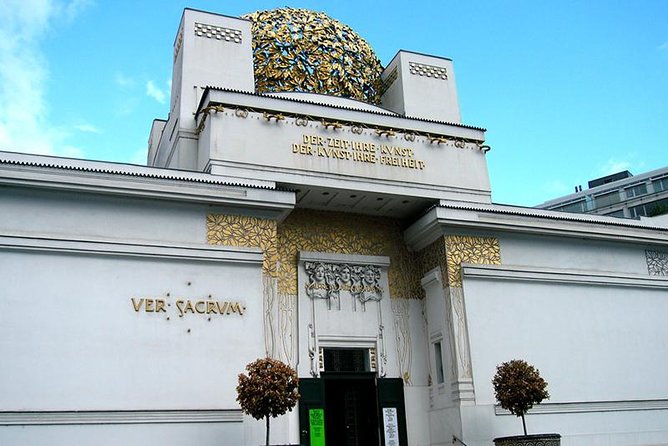
The Secession Building is one of the strongest openings in Vienna. Joseph Maria Olbrich completed it in 1898 as an exhibition hall and an architectural statement for the Vienna Secession movement.
Its white exterior and unusual dome of gilded laurel leaves make it hard to confuse with the surrounding historic buildings. The design feels deliberately fresh and slightly provocative, which was the point. Vienna’s established art world had its official institutions, and the Secession artists wanted their own space.
Inside, the major attraction is Gustav Klimt’s Beethoven Frieze. It was created for one of the group’s early exhibitions and stretches across the walls in a symbolic sequence inspired by Beethoven’s Ninth Symphony. The work is not a small Klimt painting tucked into a corner. It is a full-room experience, and the guide’s explanation can help you make sense of its figures, symbols, and unusual imagery.
Admission to the Secession House is not included. From Tuesday through Sunday, the listed prices are €9.50 for adults and €6 for students and seniors. The guide helps with payment, which is useful, but you should budget for this extra cost.
The building is also a good test of your interests. If you care about painting and symbolism, give the Beethoven Frieze time. If you mainly want exterior architecture, you can still appreciate the stop, but the indoor ticket may feel less worthwhile.
Stadtpark and the city’s public face
The walk continues through Stadtpark, a large municipal park extending from the Ringstraße toward Heumarkt. This is a shorter stop, about 15 minutes, and admission is free.
On its own, the park is not the tour’s main Art Nouveau monument. Its value comes from the change of pace. After the Secession Building’s concentrated symbolism, the park gives you room to think about how Vienna’s grand public spaces fit together.
Your guide can also use this part of the route to place the architecture in the wider city. Vienna’s Art Nouveau was not confined to galleries. It appeared in parks, streets, apartment buildings, banks, transport stations, and commercial spaces.
Do not expect a long park visit. The stop is brief, so consider it a connector rather than a major destination. The payoff comes from seeing the city as a whole rather than rushing from one famous facade to the next.
Karlsplatz, where transport became art
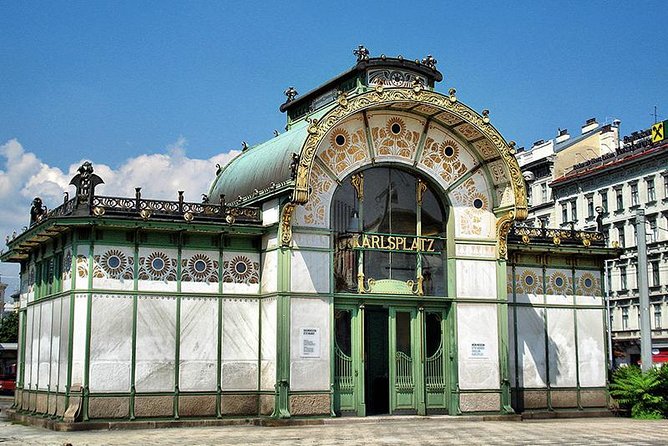
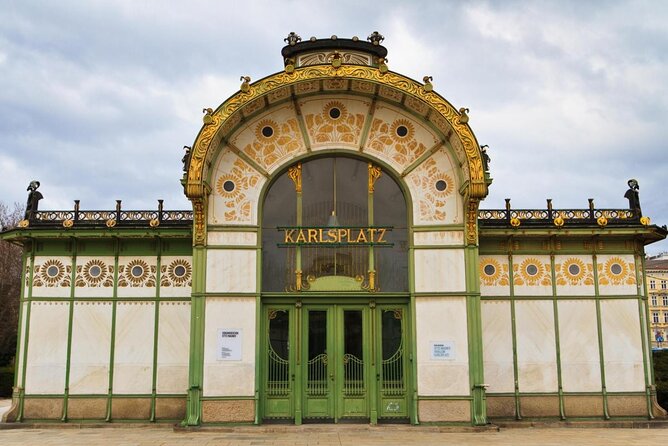
Karlsplatz is one of the tour’s most important areas. The former Stadtbahn stations here were designed by Otto Wagner with Joseph Maria Olbrich, and the buildings are among Vienna’s clearest examples of Jugendstil architecture.
The stations were built for public transport, not royal ceremony. That makes them especially interesting. Wagner was working with the practical demands of a modern transit system, yet he gave the stations a polished, carefully designed appearance.
Look for the contrast between the pale surfaces, decorative motifs, metal details, and strong geometric structure. The stations are elegant without being palaces. Their purpose is still legible, which is part of their charm.
The Karlsplatz stop lasts about 20 minutes. It is mainly an exterior architectural visit, so it suits people who enjoy composition, materials, and city planning. If you want a formal indoor museum visit at every stop, this section may feel quick.
Nearby, the Otto Wagner Pavillon offers a more focused look at the architect. The small station building now presents an exhibition about his life and work. It is open from April through October, when the museum is operating, and admission is €5 for general entry or €4 for seniors, students, Vienna Card holders, and people with disabilities.
The Pavillon is a worthwhile addition if you want context on Wagner himself. It also shows how a working transport structure could receive the level of care normally reserved for a civic monument. The extra ticket is modest, but seasonal opening means you should not assume it will be available on every date.
Same Alps, a completely different kind of day:
- Vienna: Vivaldi’s Four Seasons Concert in Karlskirche
★ 4.7 · 14,951 reviews - Vienna: Spanish Riding School Training
★ 3.9 · 9,281 reviews - Vienna: Skip-the-cashier-desk-line Giant Ferris Wheel Ride
★ 4.5 · 7,859 reviews - Vienna: Schönbrunn Palace & Gardens Skip-the-Line Tour
★ 4.7 · 7,739 reviews
Postsparkasse and Wagner’s practical modernism
The Austrian Postal Savings Bank, or Postsparkasse, is another major Otto Wagner work. It is often described as an important building of the Vienna Secession, and it shows Wagner applying modern design to a serious public institution.
The building is not merely decorative. Its appeal comes from the relationship between structure and surface. Wagner used repeated forms, controlled ornament, and modern materials to create a building that feels orderly, efficient, and unmistakably new for its time.
This is a good place to ask your guide about function. How should a bank look? How much decoration is useful? Can a public building feel modern without becoming cold? Those questions make the stop more rewarding than simply photographing the facade.
The visit lasts about 25 minutes and admission is listed as free. That helps the overall value of the route, especially after paying for the Secession Building and possibly the Otto Wagner Pavillon.
This is also where a private guide can be more useful than an audio guide. You can ask about the details you actually notice, instead of waiting through a fixed explanation. The past guides Barbara, Wolfgang, and Annelie have been praised for answering varied questions about Vienna, art, architecture, and the city’s changing identity.
Naschmarkt adds everyday Vienna
Naschmarkt is the tour’s most everyday stop. Vienna’s best-known culinary market has about 120 food stands and restaurants, and the route allows roughly 10 minutes here.
That is not enough time for a full meal or a serious market crawl. Think of it as a short look at a living part of the city after several stops focused on monuments and design.
The market also gives useful context for the nearby architecture. Vienna’s Art Nouveau was not built in a museum district sealed off from daily life. Apartment houses, markets, shops, banks, and transit lines all belonged to the same urban world.
Bring your appetite, but do not count on food being included. Food and drinks are not part of the tour price unless specifically stated. If you want to eat at Naschmarkt, plan to do so after the walk or ask your guide how the timing works on your date.
Apartment houses and nearby Secession details
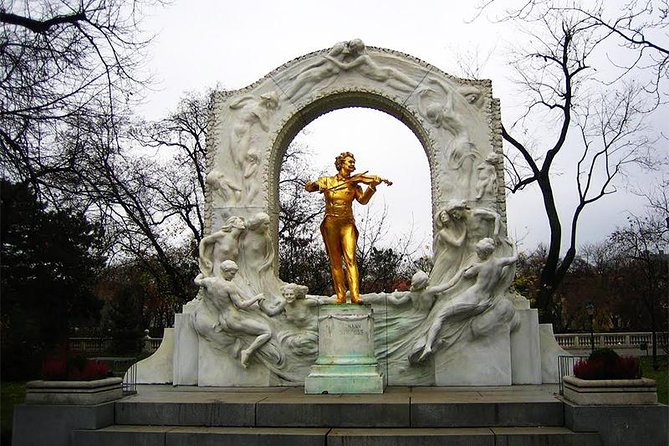
The supplied route highlights metro stations and major public buildings, while the tour’s wider Art Nouveau focus can also bring attention to residential architecture near Naschmarkt. Two apartment houses associated with Otto Wagner are often part of the story, and the Majolica Houses are among the most recognizable examples.
Their facades use colorful floral tile patterns that are far more playful than the restrained surfaces of Postsparkasse. They show how Vienna Secession ideas moved into ordinary urban housing, at least for the people who could afford to live in such addresses.
The Zacherl House is another Art Nouveau landmark associated with the central city. It has a more severe, distinctive appearance and helps show that Vienna’s modern architecture did not follow one single formula.
Because the exact stops can depend on the guide and route conditions, ask at the beginning if these residential buildings will be included. That simple question helps you set expectations, especially if the Majolica Houses or Zacherl House are high on your wish list.
What the private format changes
A private tour means only your group participates. The advertised capacity is up to 10 people, so the per-person price changes sharply depending on group size.
For 10 people, $490 works out to $49 per person before admission fees. For two people, it becomes $245 each, and that is a much harder value call. You are paying for a dedicated professional guide, a tailored pace, and the ability to ask questions, not just transportation or entry to a collection of museums.
I would choose this format for a family, group of friends, or several couples sharing the cost. It is also useful if your group has mixed interests. One person can ask about Klimt, another about engineering, and another about Vienna’s political or social changes.
The route is mostly on foot and begins at Operngasse 7 in central Vienna. The tour is near public transportation, but hotel pickup and drop-off are not included. The summary says pickup is offered, so confirm what that means for your booking rather than assuming a hotel transfer.
Who will get the most from this walk
You do not need a formal art background. One past guide, Wolfgang, specifically helped make the movement accessible to someone who already knew little about Art Nouveau. That is the right expectation: you can arrive curious and let the guide build the story from the buildings around you.
The tour is best suited to:
- Art lovers who want to see Klimt’s Beethoven Frieze
- Architecture fans interested in Otto Wagner and Joseph Maria Olbrich
- Design students or professionals looking at materials, pattern, and function
- Repeat visitors who have already seen Vienna’s imperial sights
- Groups that prefer private discussion over a fixed public tour
It may be less suitable if you want a fast overview of all Vienna sights. Three hours focused on one movement means less time for the Hofburg, museums, churches, or palace interiors.
Most people can participate, and the tour is near public transport. Still, it is a walking experience, so comfortable shoes and a willingness to move between central stops are sensible. The available information does not provide a detailed accessibility assessment, so ask the provider about your specific needs before booking.
Timing, tickets, and practical value
The tour is generally booked about 11 days ahead, which gives you a useful planning clue. You may not need to reserve months in advance, but I would book early if you need a particular guide, date, or season.
April through October is the key period for the Otto Wagner Pavillon. If that small museum matters to you, check its availability before paying. The Secession Building also has its own admission fee, listed separately from the tour.
A private guide can help with ticket payment, but the extra fees still come from your pocket. The tour price covers the three-hour guided experience and professional guide, not food, drinks, or entrance tickets.
Free cancellation is available up to 24 hours before the start time. Changes or cancellations inside that window are not accepted for a refund, so keep the local cut-off time in mind.
Should you book the Private Vienna Art Nouveau Walking Tour?
Book it if you want Vienna explained through design and architecture, not just famous names. The route links Secession painting, public transport, banking, parks, markets, and apartment buildings into one clear story.
I would especially recommend it for a group of four or more, since the $490 price becomes easier to justify. The best parts are the Secession Building, Klimt’s Beethoven Frieze, Karlsplatz, and Postsparkasse, while the short Stadtpark and Naschmarkt stops add setting rather than major sightseeing time.
Skip it if you are traveling alone on a tight budget or want a broad first look at Vienna. But if you already know the imperial center and want to understand why Vienna became such an important center for modern design, this private walk offers a focused and flexible way to see it.
FAQ
How long is the Private Vienna Art Nouveau Walking Tour?
The guided walking tour lasts approximately three hours.
How much does the private tour cost?
The price is $490 per group, with up to 10 people participating.
Is the tour private?
Yes. Only your group participates in the activity.
Are entrance fees included?
No. Entrance fees are separate. The Secession House costs €9.50 for adults and €6 for students and seniors from Tuesday through Sunday. The Otto Wagner Pavillon costs €5 for general admission or €4 for eligible reduced-rate visitors when open from April through October.
Where does the tour start?
The meeting point is Operngasse 7, 1010 Vienna, Austria.
Are hotel pickup and food included?
Food and drinks are not included unless specified. Hotel pickup and drop-off are also not included, although pickup is noted as an available feature, so confirm the details when booking.
Just added around Vienna
- World War II History Vienna Old Town Private Walking Tour★ 4.8 · 9 reviews
- From Krems: Wachau Valley River Cruise on the Danube★ 4.6 · 95 reviews
- Vienna: Winery and Wine Tasting Tour with a Wine Expert★ 5.0 · 5 reviews
- Vienna: Wine Tasting E-Bike Tour★ 4.9 · 46 reviews
- Vienna: Wine Tasting at Schönbrunn Palace★ 4.3 · 71 reviews
- Vienna: Wine Tasting Tour★ 4.8 · 61 reviews
- Vienna: Wiener Schnitzel and Strudel Cooking Class★ 4.9 · 126 reviews
- Vienna Urban Art Tour: Explore a different side of Vienna!★ 3.8 · 14 reviews
Walking Tours, compared.
Guided Walking Tour of City Center Highlights
Read our review →
Guided Walking Tour of City Highlights & Hidden Gems
Read our review →
Vienna Historic Center Small Group Walking Tour
Read our review →
Browse the lists this tour appears in