

Reviewed · WALKING TOURS
Salzburg Introduction Walking Tour
Salzburg’s story comes into focus on foot, one crooked lane and grand baroque square at a time. This 2.5-hour walk links Mozart, medieval salt wealth, St. Peter’s Abbey, the Festival Halls, and the real von Trapp family, so you get more than a parade of pretty buildings. The guide’s academic background gives the tour real substance, while the small group keeps it personal.
I like the way the route combines famous sights with less obvious details, including Salzburg’s old passageways and stories about medical innovations. I also like the practical, flexible guiding style: Lisa and Liza have adjusted stops for shade and seating, while guides such as Claudia and Natalie have shaped the walk around the group’s interests.
The main consideration is price. At $180.21 per person, this is a costly introduction to a city that is easy to explore independently. The value comes from the small group, scholarly guide, and connected storytelling, not from admissions or extras, since food, drinks, hotel transfers, and Mozart Residence entry cost extra.
Key points at a glance
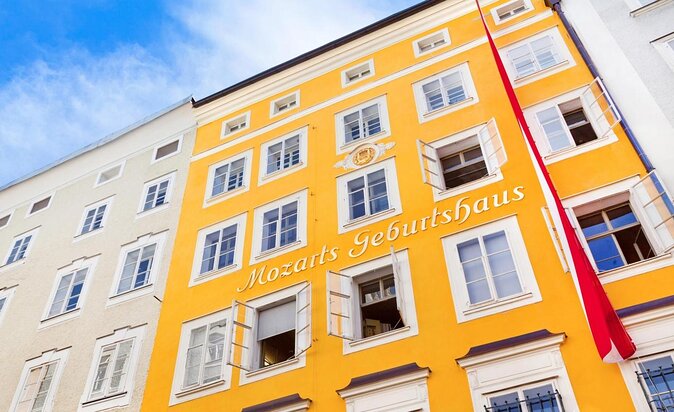
- A compact old-town route: See Getreidegasse, Mozart’s birthplace, the Festival Halls, baroque squares, and St. Peter’s Abbey in one walk.
- Academic-level guiding: Guides may be professors, doctoral students, historians, journalists, art critics, or published authors.
- Small groups matter: The experience is advertised for a maximum of six people, with additional information listing up to eight.
- More than Mozart: Learn about medieval salt commerce, medical advances, Michael Haydn, local customs, and Salzburg politics.
- The real von Trapp story: The tour places The Sound of Music family in the context of their lives and refugee experience during the Second World War.
- Useful early orientation: A morning start at 9:30 a.m. can help you decide where to return during the rest of your stay.
Why Salzburg makes sense on foot
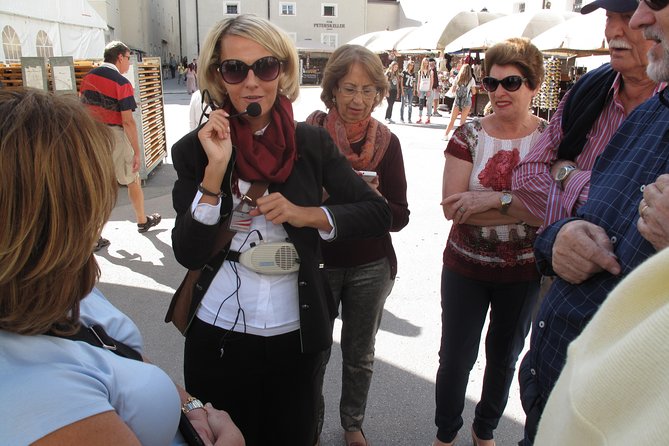
Salzburg is compact, but it is not simple. The old center shifts quickly from narrow commercial lanes to enormous squares shaped by archbishops and their court. A guide helps you read that contrast instead of treating it as a collection of attractive façades.
The walk begins at Linzer Gasse 39, a practical starting point near public transportation. From there, you head into the historic center and spend roughly two and a half to three hours moving between streets, squares, churches, and major cultural sites.
Expect a city walk, not a museum tour. You will spend most of the time outdoors, stopping for explanations rather than entering every building. That keeps the route moving, but it also means admission to the Mozart Residence is not part of the price.
The pace appears manageable for most people. One account describes more than 10,000 steps with a comfortable rhythm, so sensible shoes are important. Salzburg can also be hot in summer. Guides such as Lisa and Liza have made a point of stopping in shade or near places to sit, but you should still plan for a substantial amount of walking.
A few more Salzburg trips to weigh up
- Salzburg 2.5-Hour Walking Tour: Mozart, Old Town & More
★ 4.2 · 987 reviews - Salzburg: Old Town, Mozart, & Mirabell Gardens Walking Tour
★ 4.8 · 461 reviews - Salzburg Oldtown: Sightseeing Walking Tour with Licensed Local Guide
★ 5.0 · 392 reviews
Getreidegasse and Salzburg’s merchant quarter
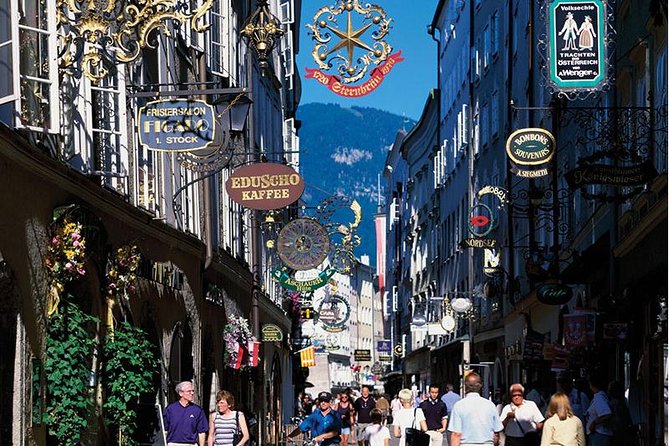
Getreidegasse is one of Salzburg’s signature streets, known for its narrow shape, old shop signs, and passageways leading between buildings. It was once part of the city’s commercial heart, and the route uses it to explain how business and daily life worked inside the medieval town.
This is a good place to look up as you walk. The street-level shops can draw your attention, but the real clues are above them: façades, signs, building forms, and the tight connections between neighboring lanes. The crooked streets are not an inconvenience to be corrected. They show how the town developed before grand planning reshaped other parts of Europe.
The route also discusses Salzburg’s salt commerce. Salt helped make the region prosperous, and that money supported the city’s religious and political power. This is one of the tour’s useful connections: the guide can show you how a trade product helped produce the churches, squares, and court culture you see later in the walk.
If you want only postcard views, this section may feel slower than expected. If you want to understand why Salzburg looks the way it does, it is essential.
Baroque squares and the archbishops’ city
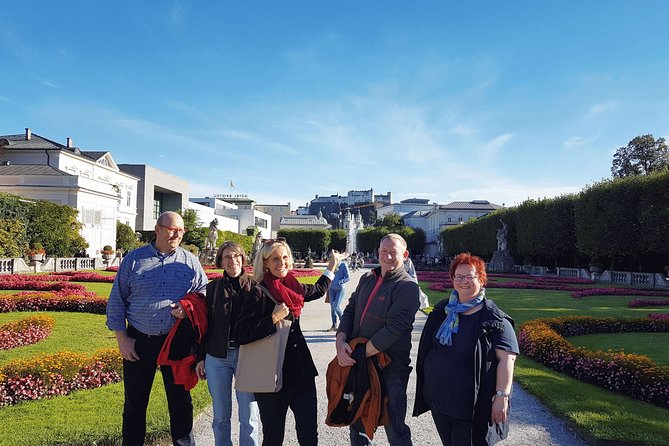
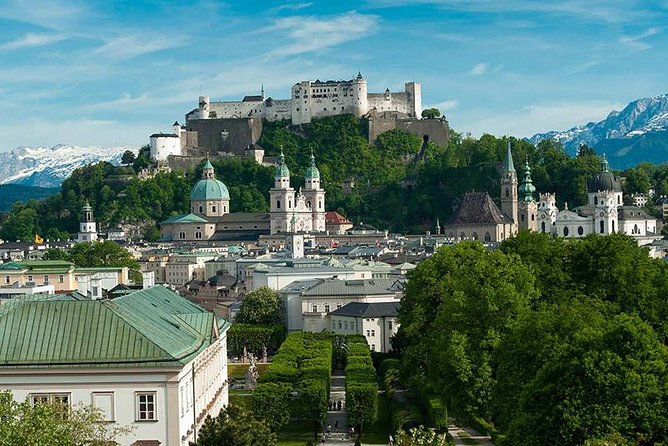
The shift from the cramped Burgher Town to the spacious baroque squares gives the tour one of its clearest visual lessons. Salzburg’s archbishops were not only religious leaders. They also ruled the city and shaped its public image through architecture.
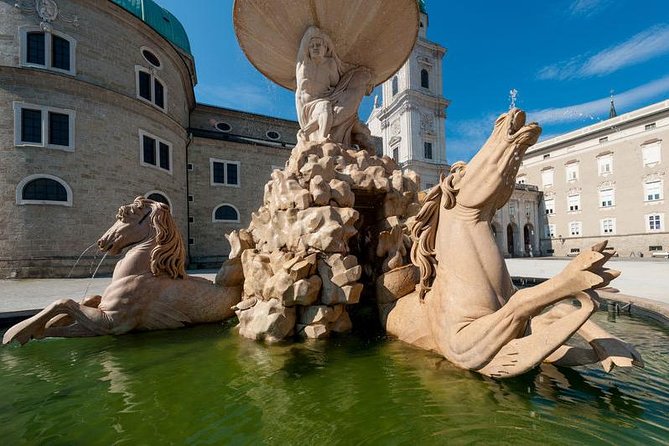
The open squares around the Residence are designed for ceremony and display. Their scale contrasts with the merchant lanes, and that contrast helps you see the social order of old Salzburg. One side reflects trade and everyday life. The other expresses authority, wealth, and the archbishops’ political reach.
A strong guide will connect architecture to people rather than simply naming buildings. Claudia, Lisa, Liza, and other guides have been praised for combining city history with stories of personalities and local customs. That human focus matters here, since grand squares can otherwise blur together.
This part also gives you useful bearings for later sightseeing. You may pass places you want to revisit for photographs, church interiors, or a quieter look after the main crowds thin out. The tour is not designed as a photography session, though, so be ready to keep moving when the group does.
Mozart’s birthplace and a wider musical story
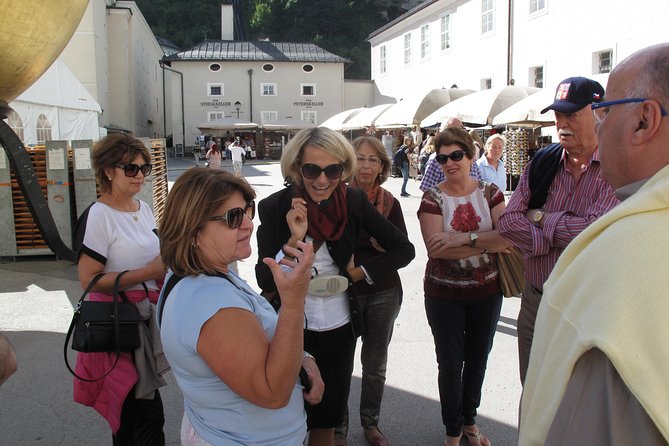
Mozart is unavoidable in Salzburg, but the tour aims to place him in the city rather than reduce Salzburg to a single famous composer. You pass Mozart’s birthplace and hear about Wolfgang and his sister Nannerl, including their childhood years in the city.
That family angle is useful. Nannerl’s role often receives less attention than Wolfgang’s, and a guide can give you a broader picture of the household and its musical life. You also hear about Michael Haydn, another major composer connected with Salzburg.
The route passes the Festival Halls, linking the city’s older musical traditions with its continuing performance culture. You learn how music became part of Salzburg’s public identity, not just a story attached to one celebrated man.
Do not expect a detailed museum visit. The tour does not include Mozart Residence admission, and its purpose is to explain the city’s musical setting from the streets. If you want rooms, objects, and a longer look at Mozart’s life, plan a separate visit and budget for the ticket.
Same Alps, a completely different kind of day:
- The Original Sound of Music Tour in Salzburg
★ 4.5 · 6,129 reviews - Salzburg: Original Sound of Music Tour
★ 4.8 · 5,059 reviews - From Salzburg: Half-Day Tour to Hallstatt
★ 4.6 · 3,596 reviews - Salzburg: Mozart Concert at Mirabell Palace
★ 4.8 · 3,498 reviews
St. Peter’s Abbey and centuries of religious power
St. Peter’s Abbey dates to 696, making it one of the oldest parts of the route. The Benedictine monastery helps explain why Salzburg became such an important religious center and why church institutions shaped so much of its culture.
The abbey is also a useful pause in the story. After the commercial lanes and formal squares, you encounter a place tied to monastic life, education, music, and religious authority. The guide can show how these institutions affected the city beyond worship alone.
The tour focuses on historical and cultural context, so the amount of time spent inside any particular church or building can vary. You should not book this expecting full interior access to every site. Instead, think of the walk as a framework that helps you understand what you later choose to enter.
One especially appealing possibility comes from the route’s attention to small, live moments. A guide once brought a group into the chapel of Nonnberg Abbey while a choir was rehearsing. That exact moment cannot be promised, and Nonnberg is not listed as a guaranteed stop, but it shows the benefit of having a local guide who notices what is happening around the city.
Salt, medicine, and the details that make the city human
A good city walk needs more than dates and rulers. This one includes stories about medieval salt commerce and medical innovations, details that broaden the usual Mozart and Sound of Music material.
Those subjects are valuable because they reveal how people lived. Trade explains money. Medicine points to practical city life and intellectual change. Local customs and traditions show that Salzburg is not just a stage set of palaces and churches.
The quality of this section depends heavily on the guide. Several named guides, including Claudia, Lisa, Liza, and Astrid, have been praised for explaining complicated subjects clearly and adding local perspective. Natalie has been noted for adapting the route to the group’s interests, which can be especially helpful if you want more social history and less music, or the reverse.
There is one fair warning: an academic guide may offer many individual facts. If the broader outline is not made clear, those details can feel scattered. One lower-rated experience specifically found the narration broken and wanted a stronger overview of Salzburg’s history. If you prefer a simple, chronological story with frequent summaries, tell your guide at the start.
The von Trapps beyond the movie
The Sound of Music is a major reason many people come to Salzburg, and this tour handles the subject as part of the city’s real history. You learn about the von Trapp family singers and the story behind their flight from Europe during the Second World War.
That context is the key benefit. The film turned Salzburg into a musical postcard, but the family’s actual life was more complicated than the screen version. The tour presents their story as an authentic refugee experience, giving the subject weight without dropping the connection to the movie.
Guides may point out filming locations and offer a local Austrian view of the family and the film. Liza has used photographs to help explain places, while another guide suggested the best spots for garden views. You may also receive ideas for places to return to later.
This is not a dedicated Sound of Music excursion. If your main goal is to visit every filming location, sing the songs, or travel into the surrounding countryside, you need a separate themed tour. Here, the movie is one strand in a broader introduction to Salzburg.
Small groups and the guide make the difference
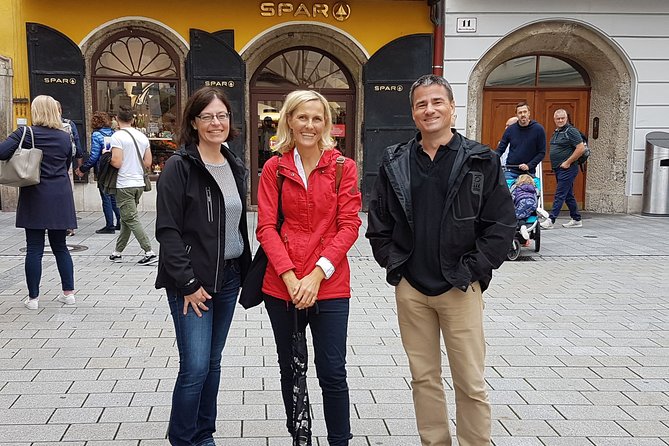
The experience is promoted as a small-group walk, with a maximum of six people in the main description. The additional information gives a maximum of eight, so check the booking details for your date if group size is important to you.
That difference matters at $180.21 per person. A small group gives you more room to ask questions, hear the guide in narrow streets, and adjust the emphasis. In some cases, the group has been only two people, allowing the guide to tailor the entire walk to personal interests.
The guides’ backgrounds are a central part of the product. You may be led by a professor, doctoral student, historian, journalist, art critic, or published author. Names praised in the supplied material include Claudia, Lisa, Liza, Natalie, Astrid, and Gabe. You cannot choose a particular guide unless the operator confirms it, but the range of backgrounds explains why the experience leans toward interpretation rather than basic sightseeing.
English is the listed language. Several guides have been praised for clear English, humor, kindness, and an easy manner. One guide even waited when a delayed train put a group 30 minutes behind schedule, though you should not assume that this flexibility is guaranteed.
Timing, comfort, and what to bring
The listed start time is 9:30 a.m. A morning departure is useful in several ways. You can learn the city’s layout before a full day of exploring, and you have time afterward to revisit a church, museum, or street that caught your attention.
Morning or afternoon departures are available according to the tour details, but the meeting information specifically gives 9:30 a.m. as the start time. Confirm your selected departure when booking.
Wear comfortable shoes and expect a long walk over historic streets. Bring water, especially in warm weather. Shade breaks have been part of the guiding style for some groups, but the route still involves outdoor exposure.
The start is near public transportation, and hotel pickup and drop-off are not included. Food and drinks are also not included. Plan to meet at the stated starting point rather than expecting a hotel transfer.
Free cancellation is available up to 24 hours before the local start time. Cancellations or changes inside that window are not refunded or accepted.
Is $180.21 a fair price?
For a standard large-group orientation, $180.21 per person would be hard to justify. Salzburg’s center is compact, and you can walk past many famous sights without paying anything.
This experience sells something different: a private-feeling, small-group conversation with a guide who has serious academic or professional training. If you are traveling with two to six people and value questions, context, and a flexible pace, the price may make sense. A small group can also be more efficient than joining a crowded walk where you hear a fixed script.
The price is less attractive if you want interior admissions, refreshments, transportation, or a tightly focused Mozart or film tour. Those are not included. You are paying for the guide’s time and interpretation.
I would see this as an orientation for visitors who care about how Salzburg developed, not just what it looks like. The strongest value comes when you use the walk to plan the rest of your stay. Guides have offered suggestions for snacks, ice cream, gardens, and places worth returning to, making the first few hours useful beyond the tour itself.
Who should book this Salzburg walk?
I would recommend it most strongly to first-time visitors who want a clear introduction before exploring alone. It also suits history buffs, music fans who want Mozart in context, and people curious about the real von Trapp story.
It works well for couples, families, and small groups who prefer questions and conversation over a fixed lecture. The comfortable pace and occasional shade stops may help, but you should still be ready for roughly 10,000 steps.
You may want another option if you dislike walking, need guaranteed indoor access, or want a full day centered only on The Sound of Music. The one lower-rated experience also offers a useful reminder: tell the guide early if you need a broad overview before detailed anecdotes.
Final verdict
Book this tour if you want Salzburg to make sense, not simply look beautiful. Its best features are the small group, the scholarly guides, the contrast between merchant lanes and archbishop squares, and the links between Mozart, Michael Haydn, salt, medicine, and the von Trapps.
Skip it if $180.21 feels too high for a walking orientation or if you mainly want admission-based sightseeing. For the right reader, though, this is a smart first morning in Salzburg. You leave with a map in your head, a better grasp of the city’s past, and a list of places worth seeing again at your own pace.
FAQ
How long does the Salzburg Introduction Walking Tour last?
The walk lasts approximately 2.5 hours. The included services describe it as a 3-hour walk, so allow roughly three hours in your schedule.
What time does the tour start?
The listed start time is 9:30 a.m. Morning and afternoon departures are available according to the tour details, so confirm the exact time you select when booking.
Where does the tour meet?
The stated meeting point is Linzer Gasse 39, 5020 Salzburg, Austria. The location is near public transportation.
What sights are included?
The route includes Getreidegasse, Salzburg’s baroque squares, Mozart’s birthplace, the Festival Halls, and St. Peter’s Abbey. It also covers local history, Mozart and Nannerl, Michael Haydn, salt commerce, medical innovations, customs, and the von Trapp family.
Is admission to Mozart’s Residence included?
No. Mozart Residence admission is not included in the tour price.
How large is the group?
The tour description lists a maximum of six people, while the additional information lists a maximum of eight travelers. Check the booking details for the group limit attached to your chosen date.
Can I cancel for a full refund?
Yes. You can cancel up to 24 hours before the experience start time for a full refund. Cancellations or changes made less than 24 hours before the start are not refunded or accepted.
Just added around Salzburg
- Private Werfen Ice Cave and Golling Waterfall from Salzburg★ 5.0 · 15 reviews
- Zell am See Alpine Village Private Day Trip from Salzburg★ 5.0 · 3 reviews
- Viator Exclusive: ‘The Sound of Music’ Private Tour★ 5.0 · 28 reviews
- Private transfer from Salzburg to Vienna, 2 hours for sightseeing★ 4.5 · 7 reviews
- Werfen World’s Largest Ice Caves and Golling Waterfalls Tour★ 4.5 · 7 reviews
- Musical Salzburg: Follow the Trail of the Beloved Movie★ 5.0 · 5 reviews
- Private Transfer from Salzburg to Munich with 2 hours for sightseeing★ 5.0 · 8 reviews
- Private Austrian Food Tasting Tour in Salzburg’s Old Town★ 4.5 · 3 reviews
Walking Tours, compared.
Guided Walking Tour of City Center Highlights
Read our review →
Guided Walking Tour of City Highlights & Hidden Gems
Read our review →
Vienna Historic Center Small Group Walking Tour
Read our review →
Browse the lists this tour appears in