
Reviewed · SELF-GUIDED TOURS
Vienna: The Great Plague Exploration Game
Vienna’s old center can feel like a museum with the doors left open. This plague-themed city game turns that museum into a puzzle trail, leading you from a 13-century church and an old Greek tavern to St. Stephen’s Cathedral, the Albertina, and the Hofburg. You use your own smartphone, follow clues, and answer questions at each stop.
I like two things right away. First, the route sends you through small streets and past details you could easily miss on a standard sightseeing walk, including a strange medieval mural and the nail-studded Stock im Eisen. Second, you can play at your own speed, stop for coffee, and continue later. The drawback is just as clear: there is no physical guide, and the app needs careful handling. Some players found answers were rejected for small typing errors, and one group gave up after trouble with the app.
Key points at a glance
- A private, self-guided route: Only your party takes part, with no set group or guide.
- Vienna’s overlooked details: Look for the old church window, the Hare House mural, and Stock im Eisen.
- A flexible 90-minute plan: Play any time between 7:00 a.m. and 10:00 p.m., and pause when you like.
- Best for families and friends: Children get a reason to watch their surroundings instead of simply trailing behind.
- Low price, with some extras: At $7.23 per person, the game is inexpensive, but admission to St. Stephen’s Cathedral and museums is not included.
- An app-based experience: You need your own smartphone, and the game is offered in English with audio stories.
How the Great Plague game works
This is not a guided walk with a person explaining every building. Questo provides a digital city game that sends you from one location to the next. At each stop, you look around, solve a clue or answer a question, and receive instructions for the next part of the route.
The title points to Vienna’s plague-era past, but the route also brings in old songs, religious art, medieval customs, famous cafés, and imperial Vienna. One thread concerns the familiar song about Lieber Augustin, and the story gives the individual verses a darker historical meaning. That storyline gives the walk more shape than a simple list of landmarks.
The route is designed for about 90 minutes. In practice, you can take longer. You might spend extra time in St. Stephen’s Square, step into a café, visit the Albertina, or pause at the Hofburg before moving on. That freedom is one of the best reasons to choose this over a fixed walking tour.
You begin at St. Rupert’s Church, Ruprechtsplatz 1, and finish at the Hofburg. The route stays in central Vienna, near public transportation. You can play any day during the stated operating hours, from 7:00 a.m. to 10:00 p.m.
A few more Vienna trips to weigh up
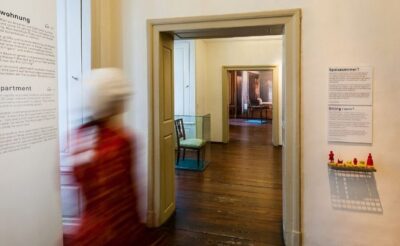
- Vienna: Tickets for Mozarthaus Vienna with Audio Guide
★ 4.2 · 2,344 reviews - Vienna: New Hofburg Palace Audio-Guided Tour & Entry Ticket
★ 4.1 · 566 reviews - Vienna: Schlumberger Wine Cellar Guided or Self-Guided Tour
★ 4.8 · 285 reviews
Starting at St. Rupert’s Church
St. Rupert’s Church gives the game a fitting opening. It is about 13 centuries old and was built with stone taken from an ancient Roman settlement. That alone makes it a useful reminder that Vienna’s story reaches much farther back than the grand Habsburg avenues most people come to see.
Inside, look for the old stained-glass window in the vaulted apse. It shows Christ on the cross, with the Madonna and Child below, and dates from the 13th century. The church also has Vienna’s oldest bells. It is dedicated to St. Rupert of Salzburg, patron saint of the Danube salt merchants.
The first challenge asks you to inspect your surroundings and find the information needed to move on. That is a good way to begin because it makes you slow down and look. The stop is planned for about 10 minutes, and admission is free.
The church has seen several renovations, so do not expect every stone to belong to the same period. In summer, it also hosts concerts of ancient music, including evening performances in July. If your game brings you here at the right time, check the church schedule before moving on.
Griechenbeisl and Vienna’s musical past
The next stop is Griechenbeisl, one of Vienna’s oldest restaurants and taverns. Its name means Greek Inn, a nod to Greek merchants and Levant travelers who once settled nearby. The location near the Holy Trinity Greek Orthodox Church adds another layer to this part of the old city.
The tavern is closely linked with Vienna’s musical past. Mozart, Beethoven, and Schubert all dined here at different times. In the Mark Twain room, you can look for framed signatures connected with famous diners, including Luciano Pavarotti and Johnny Cash.
The game asks you to search for an answer or solve a small challenge based on the place. Allow about 15 minutes. Admission to the stop is free, but eating here is not part of the game, so budget separately if you want a meal or drink.
I like this stop because it brings famous names into a real, working place rather than presenting them only on a museum label. The practical catch is that a tavern can be busy, and you may not want to linger inside if you are focused on the puzzle. You can still appreciate the exterior and nearby streets before continuing.
Bäckerstrasse and the cow with spectacles
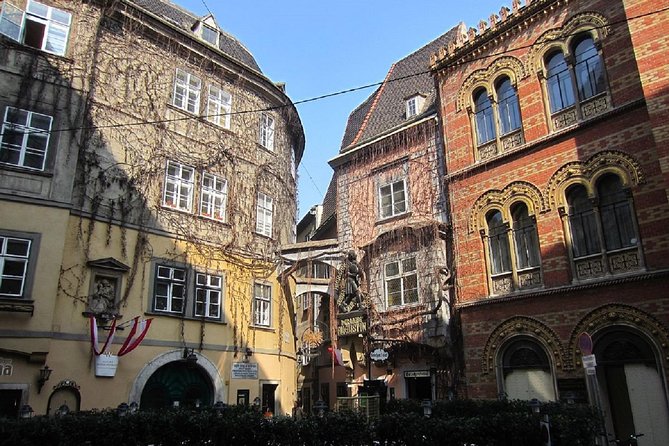
Bäckerstrasse is where the route becomes especially good for curious walkers. The street has handsome 17th and 18th-century façades and several courtyards worth noticing. The address at No. 2 is topped by a 17th-century tower, while No. 8 was the Palace of Count Seilern, built in 1722. No. 7, the Schwanenfeld House, has a Renaissance courtyard with arcades and galleries.
The game points you toward a very odd old mural on the façade of the Hasenaus, or Hare House. It shows a wolf and a cow wearing spectacles while playing backgammon. The scene may be a remnant of a larger medieval painting, or it may represent the religious conflict between Protestants and Catholics.
You get about five minutes here, but that is enough for the specific challenge. The larger value comes from the street itself. You are being trained to look above shopfronts and beyond the most famous squares. This is the sort of detail you might pass without noticing if you walked quickly from one major sight to another.
Same Alps, a completely different kind of day:
- Vienna: Vivaldi’s Four Seasons Concert in Karlskirche
★ 4.7 · 14,951 reviews - Vienna: Spanish Riding School Training
★ 3.9 · 9,281 reviews - Vienna: Skip-the-cashier-desk-line Giant Ferris Wheel Ride
★ 4.5 · 7,859 reviews - Vienna: Schönbrunn Palace & Gardens Skip-the-Line Tour
★ 4.7 · 7,739 reviews
Stephansplatz and Stock im Eisen
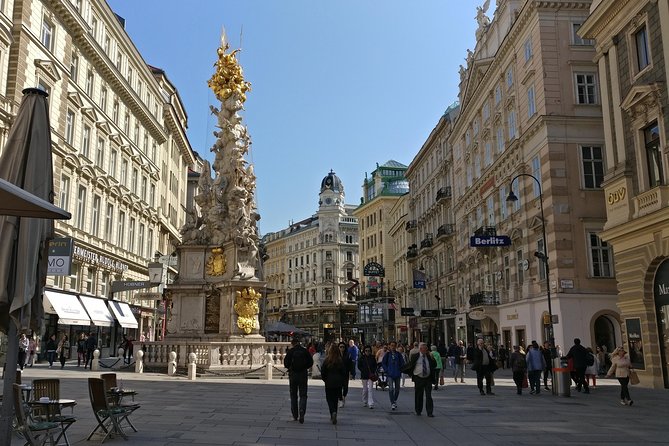
Following the clue brings you to Stephansplatz, Vienna’s central square and the setting for several later stops. The game gives you directions and another puzzle before sending you toward Stock im Eisen.
Stock im Eisen is a medieval tree trunk covered with hundreds of nails. The tradition says that hammering nails into the tree brought good luck. At one point, people even thought the object was the work of Satan. Today, the trunk sits on a 1.5-meter pedestal, surrounded by an iron ring and a dummy lock.
This is an excellent puzzle stop because the object looks so unusual. You do not need much time to see it, and the game lets you spend as long as you want before beginning the next clue. That matters in Stephansplatz, where you may want to pause, study the surrounding façades, or simply let your group catch up.
The route works well here for families. A child who has little interest in architectural dates may still want to find the nail-covered tree and figure out why it is there. That shift from passive looking to active searching is the game’s main strength.
St. Stephen’s Cathedral and its colored roof
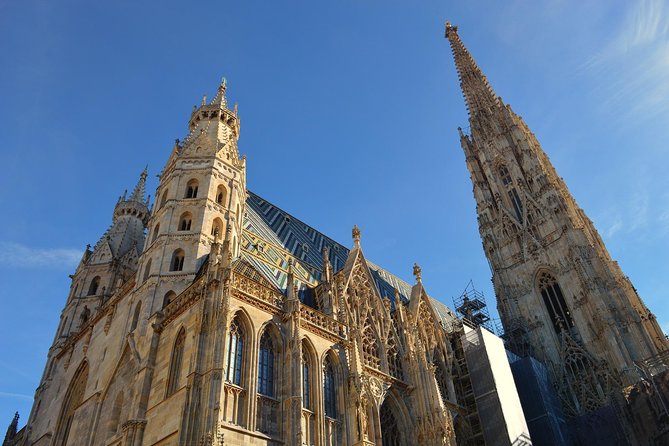
St. Stephen’s Cathedral, or Stephansdom, is the visual high point of the route. The cathedral dates from the 12th century and is one of Austria’s major Gothic buildings. You will be asked to look around for information that answers the next challenge.
The colorful roof is hard to miss. It rises 38 meters and uses about 230,000 glazed tiles arranged in patterns. The mosaics include the double-headed eagle, once a symbol of the Austrian Empire under the Habsburgs. On the north side, two other eagles carry the arms of Vienna and the Republic of Austria.
The cathedral stop is planned for about 15 minutes. The game itself does not include admission, so check any entry requirements before you go inside. The information provided does not promise access to the tower, but the cathedral’s tower room is known for its city view and 13 bells.
This is one place where the game may feel too brief if you are interested in church architecture. You can treat the puzzle as a short introduction, then stay longer on your own. That is better than expecting the app to replace a full cathedral visit.
Café Frauenhuber and a natural pause
The route also points you toward Café Frauenhuber on Rauhensteingasse. Dating from 1746, it is described as Vienna’s oldest coffeehouse. Mozart and Beethoven reportedly played table music for diners there several times between 1782 and 1791.
Frauenhuber is a useful pause in the middle of a city game. Vienna’s coffeehouse tradition is not just about grabbing caffeine. It is about sitting down, taking stock, and giving your group a break before the next set of clues.
The café is not listed as a timed stop with an admission fee, and food and drinks are not included. That is easy to understand, since you choose how long to stay and what to order. If your group needs a rest, this is the natural place to use the game’s flexible format.
The Albertina and imperial art
The Albertina brings the route into Vienna’s art world. The museum holds more than 50,000 drawings and over 1 million master prints, shown on a rotating basis. It occupies part of the largest Habsburg residential palace within the Hofburg complex.
Its collections cover modern art, graphic art, architecture, and photography. The named artistic movements include Impressionism, Fauvism, German Expressionism, and the Russian avant-garde. Monet’s The Water Lily Pond is among the works you may see, depending on the display.
The game allows about 10 minutes for this stop, but museum admission is not included. Ten minutes is enough to solve the challenge and get a sense of the setting. It is not enough for a serious museum visit.
That distinction is important when planning your day. If you want to tour the Albertina properly, buy a separate ticket and treat the game’s stop as an introduction. If your main aim is to see the city on foot, you can simply complete the puzzle outside or around the entrance and continue.
Ending at the Hofburg
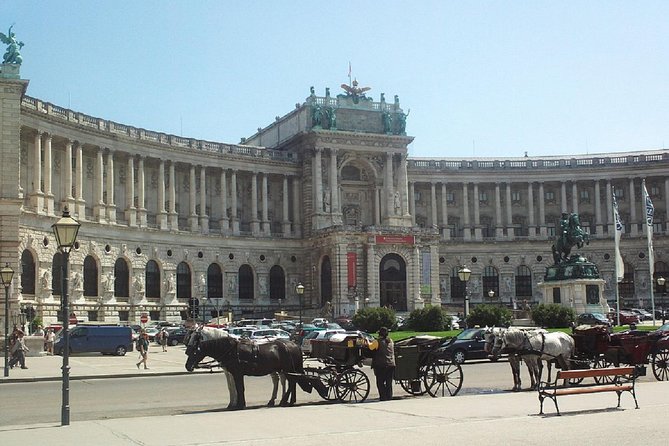
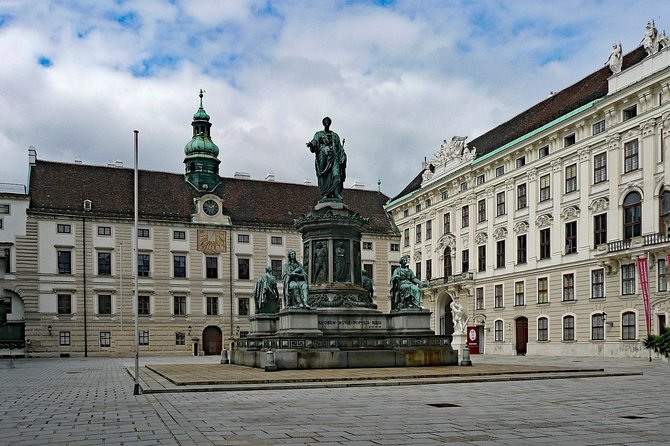
The final stop is the Hofburg, Vienna’s great former imperial center and the current home and workplace of Austria’s president. The complex has been at the heart of Vienna’s political life since the 13th century and served as the Habsburg residence and seat of government until 1918.
You can continue exploring after the final challenge. The Hofburg includes the Imperial Apartments, with 24 rooms, the Sisi Museum, and imperial silver collections. The National Library is also here. The Hall of Ceremonies, built in the 19th century, is still used for Viennese balls.
The game gives you about 10 minutes at this last stop, but the endpoint is useful because it leaves you near several major attractions. The route does not include museum admission, so decide in advance if you want to add one of those visits.
I like the ending because it does not force you onto a bus or back to a starting point. You finish in the middle of Vienna’s main sights, with the rest of the day still in your hands.
What $7.23 gets you
At $7.23 per person, this is a low-cost way to add structure to a walk through central Vienna. The price covers the digital game, clues, directions, and audio stories. It does not cover a guide, food, drinks, or entry to St. Stephen’s Cathedral, the Albertina, or Hofburg attractions.
For a family, the value improves because children play free. A private format also means you are not paying for a shared group experience that moves at someone else’s pace. Groups larger than 15 need to make multiple bookings.
The price is especially fair if you want a 90-minute activity between museum visits. It is less compelling if you want detailed lectures on Vienna’s art, politics, or architecture. One person who expected more historical explanation found the experience too light. That is a useful warning: this is a puzzle walk with historical content, not a full teaching tour.
App tips and small frustrations
You need your own smartphone, and the activity is offered in English. Confirmation arrives when you book, and the game can be played at any time after booking without rescheduling. You can pause for coffee, sightseeing, or a meal, then return to it later.
The app setup and game activation can be tricky. Support has helped resolve problems, but you should install and open everything before reaching Ruprechtskirche. Do not wait until your group is standing outside the first stop with children getting restless.
Pay close attention when entering answers. Some clues may require exact spelling, capitalization, or a particular word connecting names. A correct answer can be rejected if typed in the wrong form, which can be frustrating. If a response seems right but will not pass, check spelling and formatting before assuming the clue is wrong.
The activity permits service animals, is near public transportation, and is suitable for most people. Since you will be walking through central streets while looking at a phone, keep one person in the group focused on directions and traffic.
Who should choose this Vienna activity?
I would choose this for families with easily distracted children, couples who like puzzles, and friends who want a light afternoon activity. It also suits repeat visitors who have already seen the major squares and want a reason to inspect side streets and small details.
The private format is useful for groups that do not want to match the pace of strangers. You can also stop whenever you wish, which makes the route easier to fit around lunch, a museum booking, or a tired child.
I would not choose it as my only introduction to Vienna. The app gives you a storyline and facts, but it does not offer the back-and-forth of a guide. If you want long explanations, detailed questions answered on the spot, or a deep focus on the plague years, select a traditional guided tour instead.
Should you book the Great Plague Exploration Game?
Book it if you want a cheap, flexible way to walk through central Vienna while searching for medieval objects, old cafés, and clues. The route is strongest when you let yourself pause and notice places such as Bäckerstrasse, Stock im Eisen, and St. Rupert’s Church.
Skip it if you dislike smartphone activities or expect a polished lecture at every stop. Install the app early, read each answer carefully, and keep separate time and money for the Albertina, cathedral, Hofburg, food, and coffee.
With a 4.5 rating from 60 ratings, the experience has a solid record, but its value depends on matching your expectations. For a self-guided scavenger hunt at $7.23, it is an appealing deal. For a full historical tour, it is only a starting point.
FAQ
How long does the Vienna Great Plague Exploration Game take?
The game takes approximately 1 hour and 30 minutes. You can take longer because the activity is self-paced and allows breaks.
Where does the game start?
It starts at St. Rupert’s Church, at Ruprechtsplatz 1, 1010 Vienna, Austria.
Where does the game finish?
The game ends at the Hofburg in central Vienna. You can continue exploring the palace and nearby attractions afterward.
Is a guide included?
No. This is a private, self-guided activity played with your own smartphone. A physical tour guide is not included.
What language is the game offered in?
The game is offered in English and includes audio stories.
Are museum and cathedral admission tickets included?
No. Admission to St. Stephen’s Cathedral and the Albertina is not included. Hofburg attractions also require separate admission where applicable.
Can I pause the game?
Yes. You can play at any hour after booking, take a break for coffee or sightseeing, and continue when you are ready.
What is the cancellation policy?
You can cancel up to 24 hours before the local start time for a full refund. Cancellations or changes made less than 24 hours before the start time are not refunded or accepted.
Just added around Vienna
- World War II History Vienna Old Town Private Walking Tour★ 4.8 · 9 reviews
- From Krems: Wachau Valley River Cruise on the Danube★ 4.6 · 95 reviews
- Vienna: Winery and Wine Tasting Tour with a Wine Expert★ 5.0 · 5 reviews
- Vienna: Wine Tasting E-Bike Tour★ 4.9 · 46 reviews
- Vienna: Wine Tasting at Schönbrunn Palace★ 4.3 · 71 reviews
- Vienna: Wine Tasting Tour★ 4.8 · 61 reviews
- Vienna: Wiener Schnitzel and Strudel Cooking Class★ 4.9 · 126 reviews
- Vienna: Unforgettable Private City Tour★ 5.0 · 7 reviews
Self-Guided Tours, compared.
Tickets for Mozarthaus Vienna with Audio Guide
Read our review →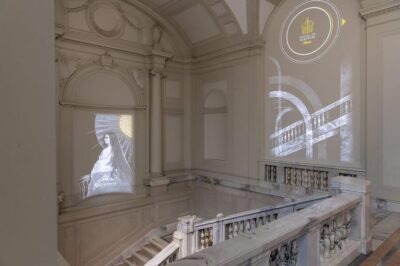
New Hofburg Palace Audio-Guided Tour & Entry Ticket
Read our review →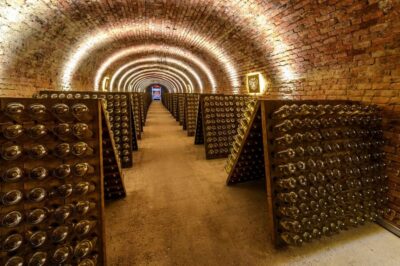
Schlumberger Wine Cellar Guided or Self-Guided Tour
Read our review →
Vienna Walking Tour with Audioguide on Your Smartphone
Read our review →
Browse the lists this tour appears in