Reviewed · PRIVATE
Vienna: Private Music Tour
Vienna’s musical story comes alive when you move from the State Opera’s backstage spaces into the streets where Mozart, Beethoven, and Johann Strauss worked and performed. I like the way this tour links grand buildings to real musical events, especially Beethoven’s Eroica premiere at Palais Lobkowitz and the Vienna Boys Choir’s Sunday home in the Hofburg Imperial Chapel. I also like that a private guide can adjust the pace, as Lisa did for one family whose mother needed extra accommodation.
The main consideration is timing. The opera portion depends on opening hours and available tour slots, and the entrance fee is not included. At $541 for a private group of up to 15, this makes the most sense for a family or group that values personal attention rather than a low-cost shared walk.
Key points at a glance
- Behind the State Opera curtain: Learn about the building, its conductors, and its place in Vienna’s musical life.
- Beethoven’s Eroica connection: Visit Palais Lobkowitz, where Beethoven premiered his Third Symphony.
- Vienna Boys Choir setting: See the Hofburg Imperial Chapel, where the choir performs every Sunday.
- Strauss and Mozart stops: Visit the former dance salon linked to Johann Strauss and see Mozart’s former home.
- Private, adaptable format: A state-certified guide can speak English or German and adjust the route when practical.
Why this private music walk works in Vienna
Vienna can feel like one enormous museum of music. Plaques, statues, concert posters, and grand halls appear at every turn, but the details do not always connect on their own. This tour gives you a clear thread: start with the city’s opera tradition, then walk through the historic center following the people and places that shaped Vienna’s music.
The format is private, which matters here. You are not trying to hear a guide over a large crowd or waiting for a group member who wants to photograph every doorway. A group of up to 15 can book together, while a smaller party gets more room to ask questions and request a comfortable pace.
The route lasts 150 minutes, or two and a half hours. That is long enough to cover several major sites without turning the outing into an all-day commitment. You finish in central Vienna at 1010 Vienna, Austria, so the tour works well as a morning introduction or an afternoon activity before dinner or a concert.
The focus is music, but the content is wider than composers alone. You hear about conductors such as Gustav Mahler, imperial Vienna, church traditions, aristocratic patrons, and the social world surrounding the waltz. If you like history with a human angle, that broader view is one of the tour’s strengths.
A few more Vienna trips to weigh up
- Vienna: Private Walking Tour with a Local Guide
★ 4.6 · 1,420 reviews - Vienna: Private Walking Tour with a Guide
★ 4.7 · 962 reviews - Vienna: Wine Tasting Experience in a Private Wine Cellar
★ 4.8 · 413 reviews
Inside the Vienna State Opera
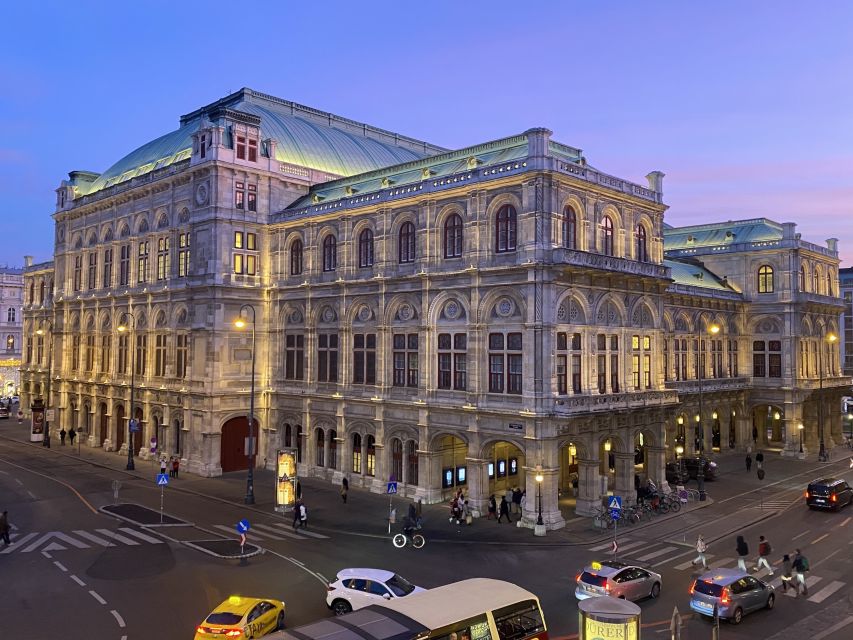
The tour begins at the Vienna State Opera, with your guide waiting by the fountain on the left-hand side of the building. This meeting point is specific, but give yourself time to identify the correct side of the opera house before the start.
The guided visit takes you behind the scenes of one of the world’s best-known opera houses. The exact rooms and path can depend on the opera house’s opening hours and available tour times, so the local partner confirms the start time after checking those conditions. That uncertainty is worth noting if you are building a tightly timed concert day.
Inside, the guide places the building in the story of Viennese music. You learn about major conductors, including Gustav Mahler, and about the opera house as a working institution rather than simply a beautiful facade. The appeal is not just the architecture. You get a sense of how performances, conductors, singers, and audiences fit into the city’s musical life.
The opera entrance fee is not included in the tour price. That is an important budgeting point, since the headline group price does not represent the entire cost of this part of the experience. Ask for the current entrance details when you confirm your time, especially because access and opening hours affect the visit.
One practical advantage is skip-the-ticket-line access. You still need to follow the opera house’s schedule, but you are not left to work out the entry process on your own. The guide handles the visit as part of the larger route.
Palais Lobkowitz and Beethoven’s Eroica
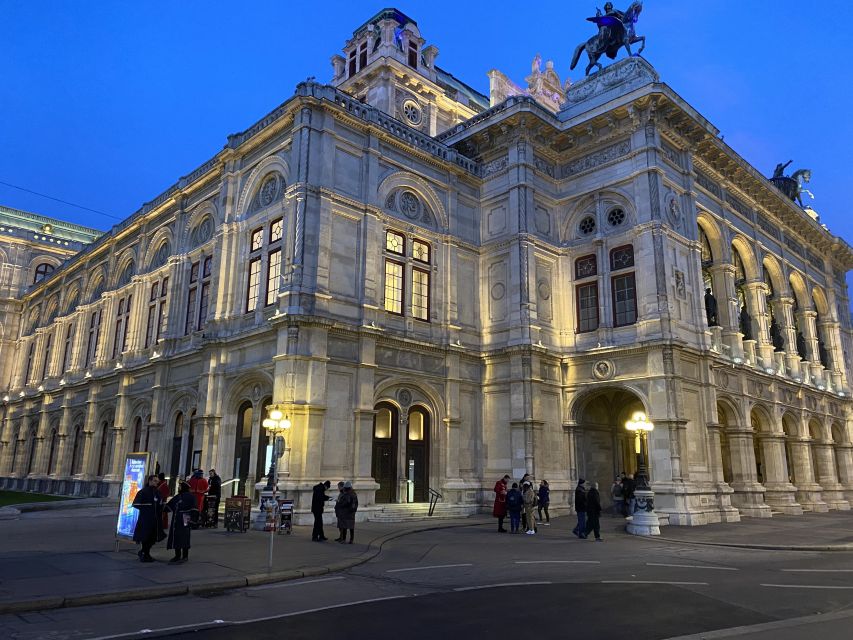
After the opera house, the tour continues on foot through Vienna’s inner city. One key stop is Palais Lobkowitz, a place with a direct link to Beethoven and his Third Symphony, Eroica.
This is more than a handsome palace stop. Beethoven premiered Eroica there, and the palace was the home of one of his main patrons. That detail helps explain how music was supported in Vienna. Composers did not work in isolation. Wealthy patrons, private salons, aristocratic households, and public institutions all played a role.
I find this kind of stop especially useful because it connects a famous piece of music to a physical room and a social setting. If you know Eroica, the reference adds weight to the visit. If you do not, the guide can still explain why the premiere mattered and how patronage shaped Beethoven’s career.
You should expect to view the site as part of a guided city walk, not necessarily as a full interior museum visit. The provided details identify Palais Lobkowitz as a stop, but they do not promise entry into every building along the route. That distinction matters if you are hoping to see a particular room.
The Hofburg Imperial Chapel and the Vienna Boys Choir
The Hofburg Imperial Chapel brings a different musical tradition into the tour. The Vienna Boys Choir performs there every Sunday, and the chapel helps explain how the choir began within Vienna’s court and church setting.
This stop gives the tour a useful change of mood. The State Opera represents professional theater and major conductors. The Hofburg Chapel points to sacred music, the imperial court, and a choir tradition that remains part of Vienna’s identity.
You may want to ask your guide about Sunday performances if your schedule includes one. The tour information confirms that the choir performs every Sunday, but it does not say that this walking tour includes a concert or guarantees that you will hear the choir. Plan on a historical visit to the chapel unless your booking details state otherwise.
The chapel is also a good reason to choose a guide instead of following a self-guided music map. A building can look impressive without telling you why it matters. Here, the guide supplies the connection between the place, the court, and the choir.
Same Alps, a completely different kind of day:
- Vienna: Vivaldi’s Four Seasons Concert in Karlskirche
★ 4.7 · 14,951 reviews - Vienna: Spanish Riding School Training
★ 3.9 · 9,281 reviews - Vienna: Skip-the-cashier-desk-line Giant Ferris Wheel Ride
★ 4.5 · 7,859 reviews - Vienna: Schönbrunn Palace & Gardens Skip-the-Line Tour
★ 4.7 · 7,739 reviews
Mozart, his former home, and St. Stephen’s Cathedral
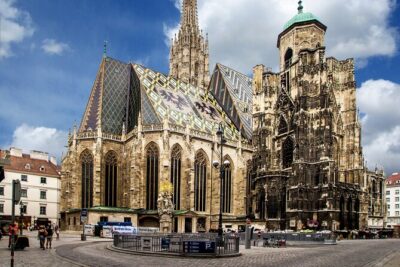
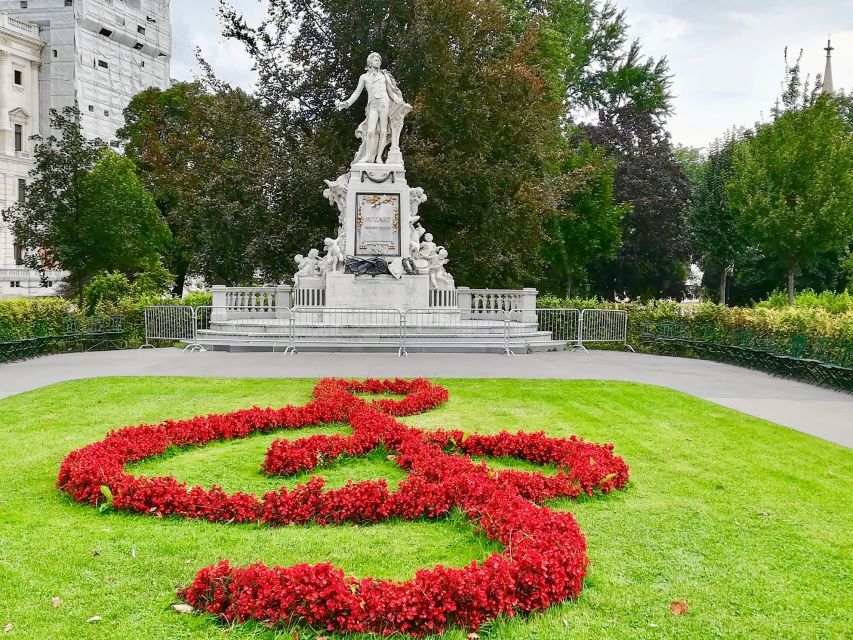
Mozart appears at several points in the route, including the Mozart Memorial and his former home. The tour also visits St. Stephen’s Cathedral, where Mozart was married.
The cathedral is one of Vienna’s defining sights, but this musical connection gives you a specific reason to look beyond the exterior. You can consider the building not only as a major church but also as part of Mozart’s personal story.
The Mozart stops work best as a set. A memorial gives you the public image of the composer. His former home adds a more personal connection. The cathedral brings in a major event from his life. Together, these sites help you see how Mozart is woven into the city rather than confined to a single museum.
The tour description does not specify whether every interior is open during your visit, so keep your expectations practical. You will be guided through the historic center and shown the named sites, but access inside individual buildings can depend on schedules and local conditions.
The waltz at Johann Strauss’s former dance salon
The route also visits the former dance salon associated with Johann Strauss, the Waltz King. This is the point where the tour moves from composers and institutions to social life.
Strauss’s music was made for public enjoyment. A dance salon helps you picture the audience, the movement, and the excitement around the waltz. It adds a lighter note to the route after the more formal settings of the opera house, palace, chapel, and cathedral.
The description promises the former salon as a stop, but it does not state that you enter a preserved ballroom or attend a dance performance. Think of it as a place-based story told by your guide. You learn why Strauss mattered and how his music affected Vienna’s social world.
That balance is useful. A tour focused only on serious concert music can miss the popular side of Vienna. Strauss brings in romance, entertainment, and the city’s love of dancing.
Pasqualati House and Beethoven’s Vienna
Pasqualati House, the former residence of Ludwig van Beethoven, adds another personal address to the walking route. After hearing about Beethoven’s public premiere at Palais Lobkowitz, you get a connection to where he lived.
The two stops complement each other. Palais Lobkowitz represents Beethoven’s relationship with a patron and a public musical event. Pasqualati House represents the composer’s daily connection to Vienna. The guide can help you see how one person’s work fits into the city around him.
Again, the supplied information does not promise a full museum entry at Pasqualati House. You should treat it as a named location on the guided walk, with the guide explaining its importance and pointing out what you can see.
I like this part of the route because it avoids reducing Beethoven to a statue and a famous tune. Addresses make the story more concrete. You are not just hearing that he lived in Vienna. You are following the city blocks connected to his work.
A private guide who can adjust the route
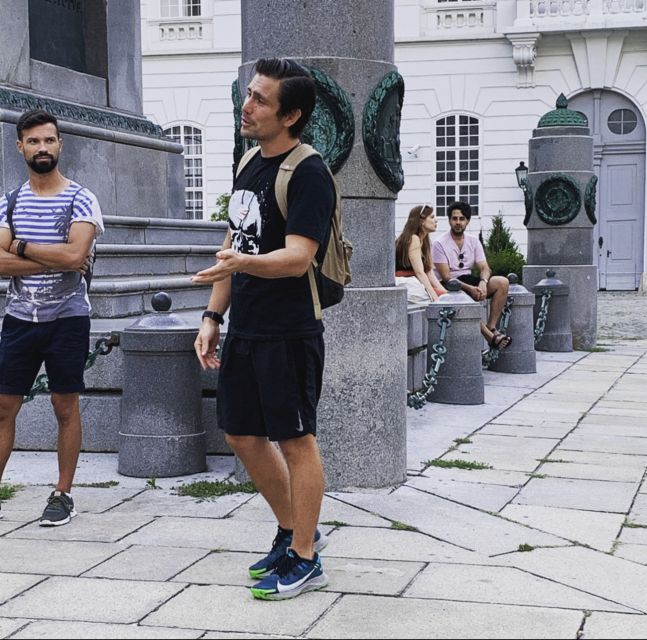
The guide is central to the experience. Tours are offered in English and German by a state-certified guide, and the private format gives you a chance to shape the visit through questions and small requests.
One guide named in the feedback is Lisa. She discussed the timing and the group’s interests before the tour, then adjusted the plan so the family could finish near a metro stop. She also made room for the children to use a playground. That detail is a useful sign of what private touring can offer: the route is not necessarily rigid from the first minute to the last.
Another guide, Giselle, was praised for the opera-house portion and for explaining the beautiful building in detail. The available comments also include strong praise for the guide’s energy and ability to keep the group involved. You should still remember that guide assignments can vary, so a particular person is not guaranteed unless the provider confirms it.
If your group includes an older parent, children, or anyone who needs a gentler pace, tell the provider before the tour. The experience is wheelchair accessible, and the route has already been adapted for individual needs in at least one case. That does not mean every street, entrance, or building condition will be identical on the day, so clear communication remains useful.
What $541 means for your group
The price is $541 per private group of up to 15 people. For a full group, the cost works out to about $36 per person before the State Opera entrance fee. A smaller group pays much more per person, so the value depends heavily on how many people are sharing the booking.
For a family or group of friends, the price buys more than a standard city walk. You receive a private guide, a dedicated music theme, opera-house access arrangements, and a route that brings together several major Vienna sites. You also avoid splitting into separate bookings if your group wants to stay together.
For one or two people, the cost is harder to justify unless music is a top priority or you place a high value on private guiding. A shared tour or self-guided route may cost less, though it will not offer the same ability to adjust the pace and finish point.
Remember to add the State Opera entrance fee. The guided opera visit is included, but the entrance fee is not. Hotel pickup and drop-off are available only if you select that option, so do not assume transportation is part of the base price.
Timing, language, and practical planning
The tour lasts two and a half hours, but the starting time is not simply fixed from the information provided. The local partner sets it according to State Opera opening hours and tour availability, then lets you know when it will begin.
That arrangement protects the opera visit from an impossible schedule, but it means you should avoid booking a tight lunch, train, or concert immediately afterward. Leave extra breathing room, especially if you want to continue exploring St. Stephen’s Cathedral or stop for coffee in the center.
English and German are available. The tour is private, so you can ask questions without worrying about holding up a large public group. If you have a strong interest in Mahler, Mozart, Beethoven, Strauss, opera, or the Vienna Boys Choir, mention it when arranging the time.
The meeting point is by the fountain on the left-hand side of the Vienna State Opera. The tour ends in central Vienna at 1010 Vienna, Austria. Hotel pickup and drop-off may be selected, but the included details do not identify a specific pickup area or transfer arrangement.
Cancellation is free up to 24 hours before the tour for a full refund. You can also reserve now and pay later, which is helpful when opera-house availability may affect the final start time.
Who should book this Vienna music tour
I would choose this tour for a group that wants a guided musical framework for central Vienna rather than a list of disconnected sights. It is especially suited to families, private groups, and visitors who want to ask questions as they walk.
It also suits people who are interested in more than one composer. The route covers Mozart, Beethoven, Johann Strauss, Gustav Mahler, the Vienna Boys Choir, and the State Opera. That range keeps the experience from becoming a single-composer biography.
Families may benefit from the flexible format. Lisa’s willingness to adjust the ending near a metro stop and allow time at a playground shows how the route can work with children and different energy levels. Still, 150 minutes of city walking may be tiring for some children, so discuss pacing before you start.
You may want to skip it if your main goal is a full concert, a guaranteed Vienna Boys Choir performance, or a long interior visit at every named site. The tour explains the places and their musical connections. It does not promise a concert, and the opera entrance fee is separate.
Should you book it?
Book this private music tour if you want Vienna’s famous names tied to real buildings, and if your group is large enough to share the $541 price. The strongest parts are the State Opera visit, the Beethoven connections at Palais Lobkowitz and Pasqualati House, and the guide’s ability to shape the pace.
For a small budget-conscious party, compare the total price with a shared walk and add the separate opera entrance fee. For families or groups of up to 15, the private setup can be worthwhile, particularly if you need accessibility adjustments, want an English-speaking guide, or prefer to finish near a convenient metro stop.
FAQ
How long does the private music tour last?
The tour lasts 150 minutes, or two and a half hours.
Where does the tour begin?
It begins at the Vienna State Opera. Your guide waits by the fountain on the left-hand side of the opera house.
Where does the tour finish?
The tour finishes in central Vienna at 1010 Vienna, Austria.
Is the State Opera entrance fee included?
No. The guided State Opera visit is included, but the entrance fee is not included.
What languages are available?
The tour is offered in English and German.
Is this a private tour?
Yes. It is a private group experience for up to 15 people.
Does the tour include hotel pickup and drop-off?
Hotel pickup and drop-off are available if you select that option.
Does the tour include a Vienna Boys Choir performance?
The tour visits the Hofburg Imperial Chapel, where the Vienna Boys Choir performs every Sunday. The provided details do not state that a performance is included.
Is the tour wheelchair accessible?
Yes, the activity is listed as wheelchair accessible.
Can I cancel for a full refund?
Yes. You can cancel up to 24 hours in advance for a full refund.
Just added around Vienna
- World War II History Vienna Old Town Private Walking Tour★ 4.8 · 9 reviews
- From Krems: Wachau Valley River Cruise on the Danube★ 4.6 · 95 reviews
- Vienna: Winery and Wine Tasting Tour with a Wine Expert★ 5.0 · 5 reviews
- Vienna: Wine Tasting E-Bike Tour★ 4.9 · 46 reviews
- Vienna: Wine Tasting at Schönbrunn Palace★ 4.3 · 71 reviews
- Vienna: Wine Tasting Tour★ 4.8 · 61 reviews
- Vienna: Wiener Schnitzel and Strudel Cooking Class★ 4.9 · 126 reviews
- Vienna: Unforgettable Private City Tour★ 5.0 · 7 reviews
Private, compared.

Wine Tasting Experience in a Private Wine Cellar
Read our review →
Private Day Tour Trip Salzburg Hallstatt and Melk from Vienna
Read our review →
Private Hidden Vienna Walk — Stories Behind Quiet Corners
Read our review →