Reviewed · TOURS
Small Group Tour; Balkans & Central Europe – Dubrovnik to Vienna
Most tours from Dubrovnik stick to the Croatian coast. This one heads inland, crossing four countries before ending in Vienna. You get Ottoman-era Mostar, Sarajevo’s layered past, Serbian river towns, Budapest’s grand avenues, and Bratislava’s compact old center in one long, road-based trip. The small group, capped at 10 people, is a real advantage.
I like the mix of major cities and less expected stops such as Blagaj, Zvornik, Sremski Karlovci, Subotica, and Győr. I also like that a tour leader stays with you, while breakfast, hotels, road costs, and selected entry fees are covered. The main concern is a serious one: the supplied tour description also promises Komani Lake and Valbona Valley in Albania, but the 10-day route given here does not visit Albania at all. Confirm the exact route before paying.
Key points to know before booking
- Dubrovnik to Vienna by road: You cross Croatia, Bosnia and Herzegovina, Serbia, Hungary, and Slovakia in 10 days.
- A maximum of 10 people: A smaller group should make border crossings, city walks, and hotel transfers easier to manage.
- Mostar and Sarajevo carry the strongest historical weight: You see Stari Most, Ottoman quarters, Austro-Hungarian streets, and reminders of the 1990s war.
- Sremski Karlovci and Subotica slow the pace: These Serbian towns add wine, Baroque buildings, Art Nouveau detail, and time for coffee.
- Breakfast and 3-star hotels are included: Lunch, dinner, drinks, snacks, and personal spending are extra.
- Check the Albania wording: Komani Lake and Valbona Valley appear in the promotional material, but not in the day-by-day route supplied for this tour.
What this 10-day road trip is really offering
This is less a hiking holiday than a fast-moving cultural road trip through southeastern and Central Europe. The route links famous places with towns you might not choose on your own, giving you a broad look at the region without asking you to arrange several border crossings, hotels, and transfers yourself.
You begin in Dubrovnik at 7:00 am and finish with a hotel drop-off in Vienna. In between, you cover long stretches by vehicle. That makes the tour efficient, but it also means you should expect regular packing, unpacking, and changes of scene.
The group limit of 10 matters here. A small van or minibus can reach city centers more easily than a large coach, and a small group usually makes it simpler to leave on time. Still, this is a schedule with many stops, not a slow stay in each city.
One practical warning deserves attention. The overview describes a two-day Albanian Alps adventure around Komani Lake and Valbona Valley, with hiking, meals, and mountain accommodation. None of those places appears in the 10-day schedule, which instead runs from Dubrovnik through Bosnia and Herzegovina, Serbia, Hungary, Slovakia, and Austria. The included services also describe bed-and-breakfast hotel stays in 3-star properties, not the mountain stay suggested by the Albania section.
If Albania is the main reason you are considering this trip, ask Choose Balkans to confirm whether you are looking at two different products. If the route below is the one being sold, judge it as a Dubrovnik to Vienna tour.
Other Austria days people book alongside this one:
- Vienna: Vivaldi’s Four Seasons Concert in Karlskirche
★ 4.7 · 14,951 reviews - Vienna: Spanish Riding School Training
★ 3.9 · 9,281 reviews - Vienna: Skip-the-cashier-desk-line Giant Ferris Wheel Ride
★ 4.5 · 7,859 reviews
Day 1: Mostar, Stari Most, and the spring at Blagaj
Your first morning starts early. A local driver collects you from your Dubrovnik hotel at 7:00 am and takes you to the border, where you meet the tour leader. Border procedures can shape the day, so keep your passport easy to reach and avoid planning a late dinner or fixed evening appointment.
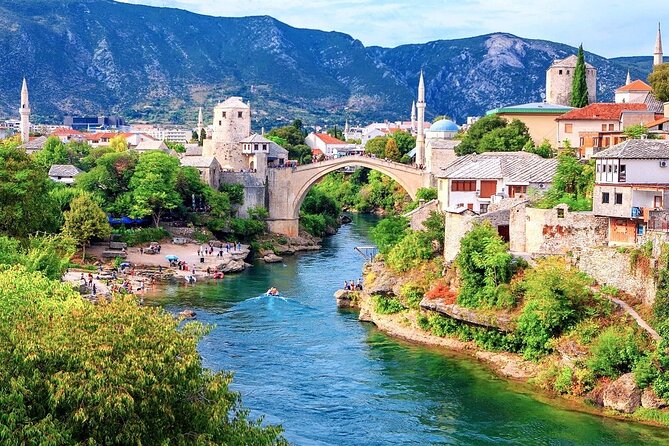
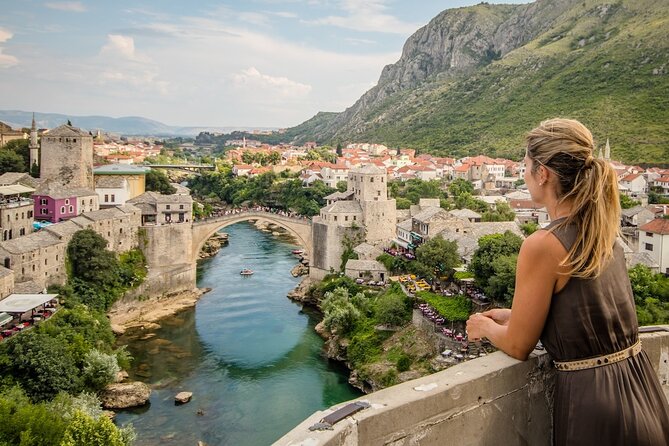
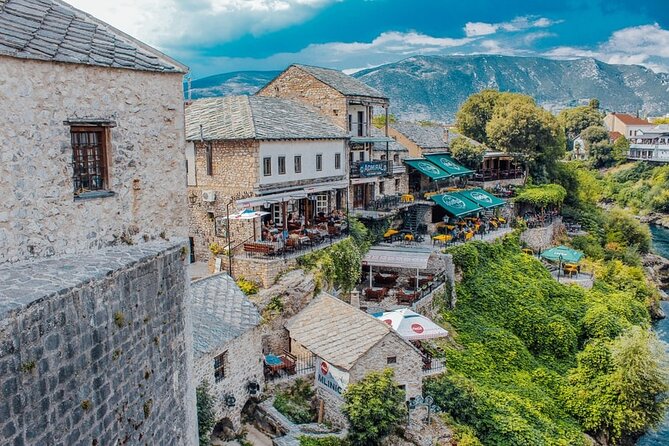
Mostar is the first major stop. Its famous Old Bridge, Stari Most, arches over the Neretva River and is part of the UNESCO World Heritage area. The bridge’s Ottoman design gives the old center a look unlike Dubrovnik’s stone lanes, and the surrounding bazaar adds small shops, cafés, mosques, and cobbled streets.
You have about an hour at the bridge, another hour in the Old Bazaar, and later about an hour of free time in Mostar. That is enough for a first look and a meal, but not enough for a deep visit to every museum or religious building. Use the free time for a relaxed walk rather than trying to collect every sight.
The nearby stop at Blagaj is a good change of pace. The historic tekija sits below a cliff beside the clear spring of the Buna River. You get a striking natural setting and a quieter view of Ottoman-era Herzegovina. Admission is included.
The drawback is the amount of driving on the opening day. You leave Dubrovnik early, cross a national border, visit several sites, and continue through the region. The reward is a strong first impression of Bosnia and Herzegovina, but you will want comfortable shoes and water.
Day 2: Sarajevo from Ottoman lanes to Latin Bridge
The road from Mostar leads to Sarajevo, Bosnia and Herzegovina’s capital. The guided walk covers the city’s origins, the medieval Bosnian Kingdom, the Ottoman period, and Austro-Hungarian rule.
Sarajevo is valuable because its different eras sit close together. Markets, mosques, churches, and synagogues appear within the same urban fabric, allowing you to see how several faiths and empires shaped the city. The route also points out bullet holes, cannon marks, and other reminders of the Yugoslav War.
You visit Latin Bridge, where the 1914 assassination of Archduke Franz Ferdinand helped trigger World War I. The bridge itself is modest, but the event attached to it changed Europe. A good guide can make this stop meaningful without turning the walk into a lecture.
There is free time for traditional meat dishes and desserts in the old town. Sarajevo is a good place to let your guide point you toward local food, since the included package covers breakfast only. Lunch, dinner, drinks, and snacks are your responsibility.
The walking can include uneven ground and war-damaged areas. You need a moderate level of fitness, though the supplied information does not describe a strenuous hike. Wear shoes with a firm sole.
Day 3: Zvornik and Belgrade’s two-river view
The stop at Zvornik breaks up the drive toward Belgrade. Set along the Drina River, the town offers time for lunch or a short walk through its streets. It is a modest stop, but that is part of its appeal: you get a glimpse of a smaller Serbian town rather than moving only between capitals.
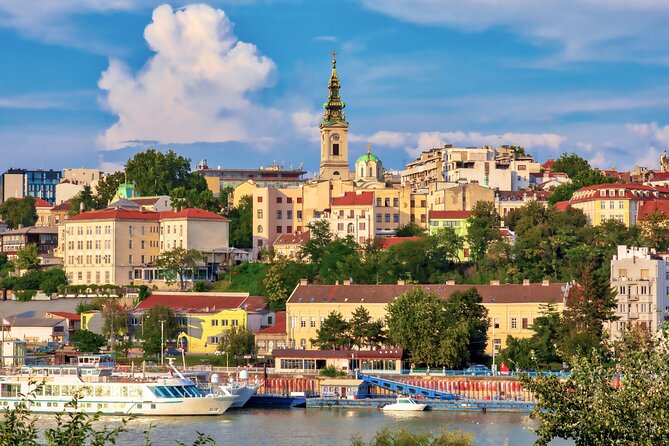
In Belgrade, the focus is the fortress and Kalemegdan Park, where the Sava and Danube meet. The high position gives you one of the best broad views of the city and its rivers. The Pobednik monument in the Upper Town adds a useful landmark and a piece of modern Serbian history.
The walk continues through Knez Mihailova, Belgrade’s main pedestrian street, toward Republic Square. Two hours is enough to get your bearings and see the central sights, but Belgrade deserves more time than this schedule provides. If you like nightlife, museums, or a longer look at the fortress, your free evening and any spare moments matter.
Same Alps, a completely different kind of day:
- Vienna: Schönbrunn Palace & Gardens Skip-the-Line Tour
★ 4.7 · 7,739 reviews - Vienna: Light of Creation Votive Church Immersive Light Show
★ 4.8 · 6,779 reviews - Vienna Spanish Riding School Guided Tour
★ 4.7 · 6,765 reviews - Vienna: Classical Concert in the World-Famous Musikverein
★ 4.6 · 6,673 reviews
Day 4: Wine country and Baroque Sremski Karlovci
Sremski Karlovci is one of the most distinctive smaller stops on the route. Its Baroque center reflects its role as a Serbian cultural and religious center in the 18th century. The town is compact, so the three-hour visit gives you time to look up at façades, hear local stories, and pause for wine.
The Four Lions fountain comes with a local tale: drinking from it is said to bring you back to Karlovci, possibly to marry there. Treat it as a bit of folklore, then leave room for the more practical pleasure of tasting regional wines.
Wine tasting is not listed as an included feature, so budget separately for it. That is useful to know because this stop works best when you allow yourself time at a cellar or café instead of rushing back to the vehicle.
Sremski Karlovci provides a welcome contrast to the large cities. You see Serbian culture through architecture, vineyards, and local tradition rather than through monuments alone.
Day 5: Novi Sad and Petrovaradin Fortress
Novi Sad is often called the cultural capital of northern Serbia. Its position near the old border between the Ottoman and Austro-Hungarian worlds helps explain the mix of architectural styles.
The guided city walk follows the pedestrian streets of Zmaj Jovina and Dunavska. Their cafés, shops, and old buildings make this a pleasant place to walk without a packed list of monuments. Petrovaradin Fortress, known as the Gibraltar on the Danube, is the major sight. Its elevated position gives you a broad look over the river and city.
You spend the night in Novi Sad, which makes Day 5 less rushed than a simple passing stop. The included accommodation is in a 3-star hotel, based on double, twin, triple, or quadruple room occupancy. Solo guests should confirm the price and room arrangement before booking, since the published rate is calculated around shared rooms.
Day 6: Subotica’s Austro-Hungarian colors, then Budapest
Subotica is a strong choice for the final Serbian stop. The City Hall dominates the central square, which also includes a park and fountains. The city’s old wealth shows in its decorative buildings and colorful façades.
The visit includes the Cathedral of St. Teresa of Avila and the Synagogue. You also receive free time for coffee, local food, or a slower look at the streets. This is the kind of stop where wandering pays off. The formal walk introduces the main buildings, while your own time lets you notice the smaller details.
Later, you cross into Hungary and continue to Budapest. The listed transfer time is only 30 minutes, but the full drive from Subotica and border procedures may make the day feel longer. Keep some flexibility in your plans.
Day 7: Budapest, Buda Castle, and a free evening
Budapest gets the fullest city treatment on the route. The Danube divides the traditional Buda side from Pest, and the guided sightseeing takes in both the city’s grand scale and its historic center.
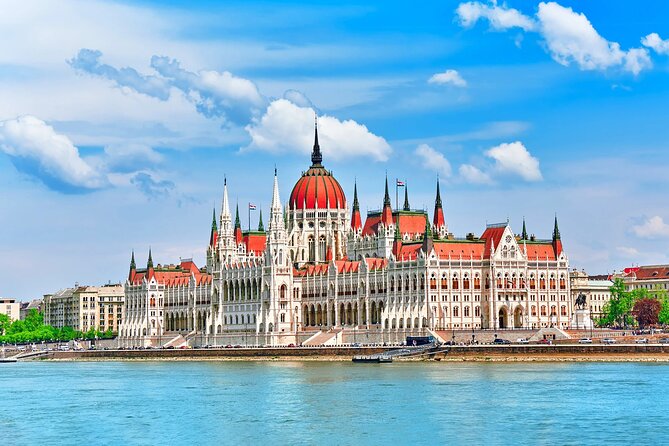
You pass St. Stephen’s Basilica, the Opera, Parliament, Heroes’ Square, and Fisherman’s Bastion. These sights cover several architectural periods, from Neoclassical and Baroque work to Art Nouveau details. The views from the Buda side are especially useful for understanding how the river shapes the capital.
Entry to Buda Castle is included. The castle area is part of the UNESCO World Heritage setting and gives the day a clear historical anchor. The schedule allows about two hours for the city tour, one hour at the castle, and another hour for city exploration, followed by a free evening.
That free night is important. Budapest is more enjoyable when you can choose your own pace, perhaps sitting near the Danube, looking for Hungarian food, or returning to a favorite street. The tour gives you an introduction, but it cannot cover the capital fully in one day.
Day 8: Győr’s churches, cafés, and road to Bratislava
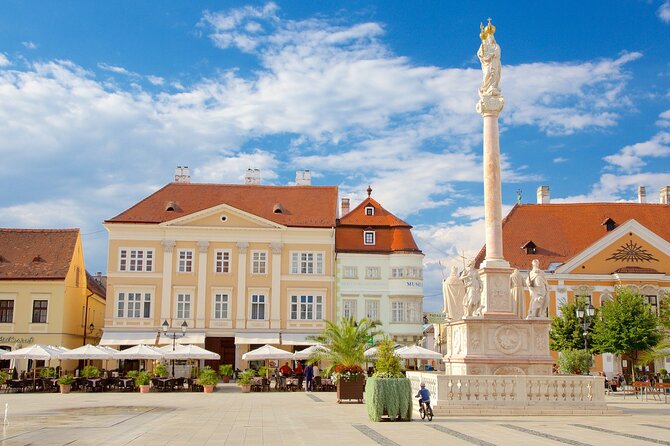
Győr, known as the City of Rivers, is a short but worthwhile stop between Budapest and Bratislava. Its center has multicolored houses, Baroque buildings, and churches gathered close enough to see on foot.
The Town Hall has a 59-meter tower with a green top. The Cathedral of the Virgin Mary traces its origins to the 11th century, while the synagogue is noted for its large gray dome and Central European design influence.
Baross Gábor Way is the practical heart of the visit. It is pedestrian-only and lined with cafés, shops, bars, and restaurants. You have time to try Hungarian food, and the schedule specifically mentions blueberry beer. Since meals are not included, this is another place to plan your own spending.
The short stop means you should not expect a full museum visit or an extensive look at Győr. Think of it as a well-chosen walking break before continuing to Slovakia.
Day 9: Bratislava’s medieval center and castle hill
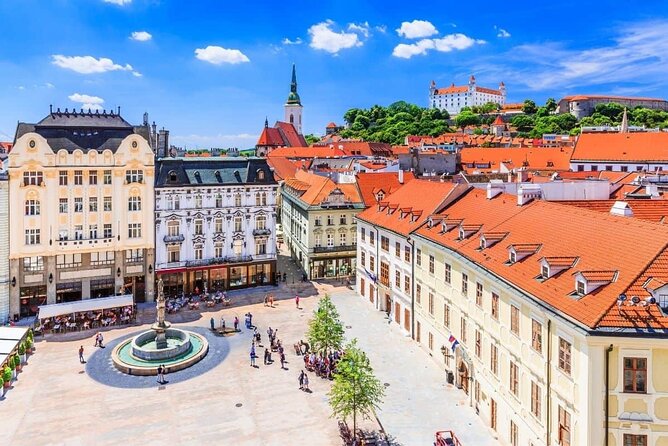
Bratislava is compact and easy to sample on foot. The old center includes the Old Town Hall, churches, cultural institutions, embassies, and Slovak government buildings.
Michael’s Gate is the only surviving gate from the medieval fortifications and one of the oldest structures in town. It is a quick stop, but it helps you picture the former walled city.
Bratislava Castle sits above the Danube and provides the day’s best viewpoint. Entry is included, and the walk up gives you a final look over the city before returning to the center.
Leave time for café culture in the afternoon. Coffee is one of Bratislava’s pleasures, and an unhurried café stop can balance the steady sightseeing pace. The city is a good place to end the guided portion because the old town is manageable and your free time is easy to use.
Day 10: Hotel drop-off in Vienna
The final day is simple: your tour leader drops you at your hotel in Vienna. The supplied details do not give a fixed drop-off time, so do not book a morning flight or a tightly timed onward connection without confirming the schedule.
Ending at your hotel is convenient. You avoid arranging a final transfer after nine days on the road, and Vienna works well as a next destination or as the end of a wider European trip.
What the $3,773.83 price includes
At $3,773.83 per person, this is not a budget bus ride. The price covers nine nights in 3-star hotels with breakfast, a professional tour leader, Dubrovnik pickup, Vienna hotel drop-off, international car insurance, tourist taxes, road taxes, petrol, and listed entry tickets.
That bundle has real value if you would otherwise arrange five countries, several border crossings, multiple hotels, and intercity transport yourself. A group of no more than 10 also gives you a more personal setup than a large coach tour.
The price is less attractive if you prefer independent travel, already have accommodation, or want long stays in Budapest, Belgrade, Sarajevo, and Vienna. Lunches, dinners, drinks, snacks, souvenirs, and personal purchases are not covered. Room pricing assumes double, twin, triple, or quadruple occupancy, so ask about a single supplement if you are traveling alone.
The biggest value question is the Albania mismatch. Do not assume Komani Lake, Valbona Valley, mountain meals, or two-day hiking are part of this exact route. Get written confirmation before committing.
Who will enjoy this route most
I would recommend it to you if you want broad regional coverage and prefer someone else to handle the driving, hotel sequence, fuel, road charges, and border logistics. It suits people who enjoy guided city walks, historic architecture, local food breaks, and a full schedule.
You should be comfortable with early starts, long road sections, uneven walking surfaces, and frequent changes of hotel. The tour asks for moderate physical fitness, and the Sarajevo walk in particular includes uneven terrain.
I would not choose it if you want a relaxed beach holiday, a dedicated Albanian Alps hike, or several days in each capital. The route is designed for variety, not depth.
Guide quality can shape a trip like this. Names associated with the company’s guide team include Bilbil, Mira, Sokol, Armando, and Ani. The strongest practical qualities attached to these guides are friendliness, local knowledge, flexibility with free time, and willingness to help with site visits. That is encouraging, but guide assignments can change, so treat those names as examples rather than a promise.
Booking details worth checking
Confirmation is provided at booking, hotel pickup begins in Dubrovnik at 7:00 am, and hotel drop-off is provided in Vienna. The maximum group size is 10.
The tour is non-refundable and cannot be changed after booking. Check passports, border requirements, room occupancy, the exact hotel locations, and the final route before you pay.
Weather, strikes, holidays, site closures, renovations, and other events can force changes. That is normal on a multi-country road trip, but the more fixed your onward plans are, the more carefully you should confirm the final schedule.
Should you book the Dubrovnik to Vienna tour?
Book it if your goal is to see a wide slice of the Balkans and Central Europe in one organized trip. Mostar, Sarajevo, Belgrade, Budapest, and Bratislava give you plenty of major sights, while Blagaj, Zvornik, Sremski Karlovci, Subotica, and Győr keep the journey from becoming a parade of capitals.
The small group and included road costs make the package easier to manage than planning the same route alone. I would book only after confirming one key point: does your departure include the listed Dubrovnik to Vienna route, or the separate Albanian Alps program? If you want Komani Lake and Valbona Valley, do not rely on the general description. If you want a well-supported overland route ending in Vienna, this can be a useful and ambitious choice.
FAQ
Where does the tour start?
The tour starts in Dubrovnik, Croatia, with hotel pickup at 7:00 am.
Where does the tour end?
The tour ends with drop-off at your hotel in Vienna, Austria.
How long is the experience?
The tour lasts approximately 10 days.
What countries does the scheduled route visit?
The scheduled route goes through Croatia, Bosnia and Herzegovina, Serbia, Hungary, Slovakia, and Austria.
Are hotels and breakfast included?
Yes. Accommodation and breakfast are included for all overnight stays in 3-star hotels. Room pricing is based on double, twin, triple, or quadruple occupancy.
Are lunch and dinner included?
No. Lunch, dinner, drinks, snacks, souvenirs, and personal spending are not included.
How many people can join the group?
The group has a maximum of 10 travelers.
Is the tour refundable if I cancel?
No. The experience is non-refundable and cannot be changed for any reason after booking.
Just added around Austria
- Ottakringer Brewery tour★ 4.0 · 6 reviews
- New Hofburg Palace Tour House of Habsburg★ 4.5 · 5 reviews
- Private Van & Walk Tour – One Perfect Day in Vienna★ 5.0 · 21 reviews
- True Crime mobile puzzle rally Vienna★ 4.0 · 3 reviews
- Vienna Naschmarket Food Tasting Tour★ 4.0 · 30 reviews
- Vienna Nightlife Experience: Food, Wine, Cocktails & Vibes★ 5.0 · 119 reviews
- Myth Mozart★ 4.0 · 80 reviews
- ( Night Tour ) With Private Guide + wine or prosecco★ 4.0 · 12 reviews
Tours, compared.
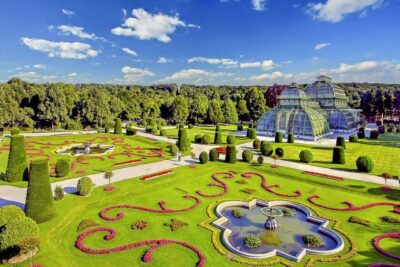
Schönbrunn Palace & Gardens Skip-the-Line Tour
Read our review →

Skip-the-Line Sisi Museum, Hofburg and Gardens Tour
Read our review →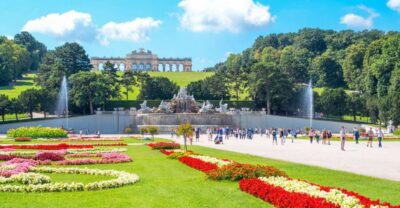
Skip-the-Line Schönbrunn Palace & Gardens Tour
Read our review →
Guided Walking Tour of City Center Highlights
Read our review →